Ever wrestled with curtains that block your French doors or leave frustrating gaps? You’re not alone. Over half of homeowners measure incorrectly for French door curtains, leading to costly replacements and installation headaches. Unlike standard windows, these elegant architectural features demand precise measurements that account for door swing, hardware clearance, and dramatic height. Getting it right transforms your space with flowing panels that enhance light control, energy efficiency, and visual appeal while ensuring smooth operation. This guide delivers professional measurement techniques so you can achieve that coveted floor-sweeping drape or clean modern look without guesswork.
The stakes are high with French doors—measure just 1/4 inch off and you’ll face crooked panels, blocked handles, or curtains that catch when opening. But with the right approach, you’ll avoid the most common pitfalls that plague DIYers. By the end of this guide, you’ll know exactly how to calculate width for optimal fullness, determine height for that perfect floor kiss, and position hardware to clear door swings. Let’s turn measurement anxiety into confidence with techniques that work for both inward and outward-swinging doors.
Why French Door Measurements Differ From Standard Windows
French doors introduce unique challenges standard windows don’t face. Their operating mechanism creates a critical clearance zone you must measure around—ignoring this causes curtains to snag when doors open. Unlike fixed windows, these panels require 4-12 extra inches of width per side to ensure fabric clears the entire swing arc when drawn open. The height-to-width ratio also demands special attention; their narrow proportions mean even small measurement errors create visibly skimpy or bunched curtains. Most importantly, inside mounts rarely work due to trim interference and door swing clearance needs, making outside mounting your only practical option for functional curtains.
The Door Swing Clearance Zone You Must Map First
Before touching your tape measure, trace your door’s swing path with a pencil. Open the door to 90 degrees and mark the outermost point the handle reaches on the floor. This arc defines your curtain’s no-go zone—fabric must stack completely outside this boundary when open. Measure from the door frame edge to your pencil mark; this distance determines your minimum rod extension. For example, if the handle swings 10 inches out, your rod must extend at least 12 inches past the frame to prevent curtain interference. Skipping this step causes the #1 frustration: curtains constantly catching in closing doors.
Why Inside Mounts Fail on Operating French Doors
While inside mounts create clean looks on fixed windows, they’re nearly impossible on functional French doors. The door trim typically lacks depth for rod brackets, and even if installed, the swinging door would collide with curtains during operation. One homeowner’s attempt at an inside mount resulted in torn fabric and dented trim within weeks—the door handle literally ripped the curtain off its rings. Outside mounting isn’t just easier; it’s the only method that accommodates both door movement and elegant fabric flow. Reserve inside mounts for decorative French door windows only.
Essential Tools for Precision French Door Measurements

Using improper tools guarantees measurement errors with French doors. A flimsy cloth tape measure stretches during use, introducing 1/2-inch inaccuracies that compound across tall panels. You’ll need three non-negotiable items: a rigid metal tape measure with lock mechanism, a dedicated notebook (not your phone—battery dies mid-measurement), and a sturdy step ladder for ceiling-high installations. The metal tape’s rigidity prevents sagging on vertical measurements over 6 feet, while physical notes avoid digital distractions that cause missed steps.
Why Your Tape Measure Choice Makes or Breaks Accuracy
Skip retractable plastic tapes—they flex when extended beyond 4 feet, throwing off height readings. Professional installers use 25-foot metal tapes with magnetic tips that grip door frames during solo measurements. Test yours: extend it fully and press the tip against a door frame. If it wobbles, discard it. For French doors, measure twice at different heights—the top near the header and bottom near the threshold—since frames often warp over time. Record both numbers; if they differ by more than 1/4 inch, you’ve found why previous curtains hung crooked.
The Measurement Notebook Technique That Prevents Costly Errors
Don’t trust memory—sketch a simple door diagram in your notebook with labeled measurements. Note “Left Door: 36.25″ W x 84.5″ H” and “Right Door: 36.5″ W x 84.75″ H” immediately after measuring. This catches subtle variations between panels that cause uneven stacking. One client discovered their 100-year-old home had doors differing by 3/8 inch—enough to make curtains hang at different heights. Always write measurements in pencil; you’ll adjust numbers as you account for hardware. Digital photos of your sketch prevent mix-ups when shopping later.
How to Calculate Exact French Door Curtain Width
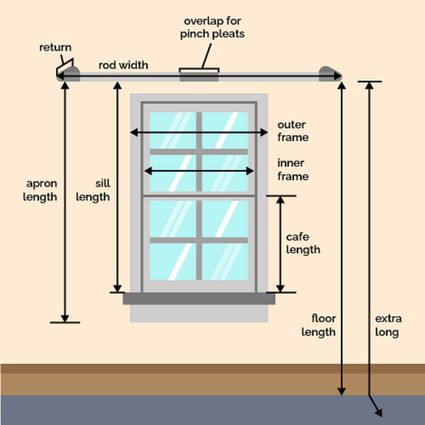
Your width measurement determines whether curtains look luxurious or skimpy. Start by measuring the total exterior width of both door frames including trim—this is your baseline number. Now add 4-12 inches per side depending on your desired fullness and room size. For standard living rooms, extend 6 inches past each outer frame edge. In grand foyers, go 10-12 inches for dramatic effect. This extended width becomes your rod length. Crucially, your actual curtain panels must total 2-2.5 times this rod length for proper fullness—so a 96-inch rod needs 192-240 inches of curtain width.
Step 1: Measuring Total Frame Width Including Trim
Place your tape measure at the outermost edge of the left trim molding and extend to the right trim’s outer edge. Record this number—don’t assume both sides match. Most French doors have slight variations; one side might be 36.25 inches while the other is 36.5 inches. Measure at three heights: near the top header, middle latch point, and bottom threshold. Use the widest measurement to ensure full coverage. If your doors have decorative sidelights, include them in this measurement for a unified look.
Step 2: Adding Critical Side Extensions for Clearance
Now add 4-12 inches per side beyond the frame edges. Why? When curtains open, fabric stacks back against the wall. Without this extension, panels block light and door operation. Minimum 6 inches per side prevents visual crowding—less looks skimpy, more creates luxurious pooling. For doors in high-traffic areas like kitchens, add 8+ inches so curtains clear busy pathways. Calculate: (Frame Width) + (6″ Left) + (6″ Right) = Rod Length. A 72-inch frame needs an 84-inch rod minimum. This extra space lets fabric breathe when doors swing open.
Step 3: Calculating Curtain Panel Width for Professional Fullness
Don’t confuse rod length with curtain width—this is where most DIYers fail. Your panels must total 2-2.5 times the rod length for elegant folds. For a 90-inch rod, buy 180-225 inches of curtain width (usually two 90-112.5 inch panels). Light fabrics like sheers need 2.5x fullness; heavier blackout curtains work at 2x. Never buy panels matching your rod length—they’ll look flat and sad. Pro tip: if mixing sheers and drapes on double rods, calculate fullness separately for each layer since fabrics drape differently.
Determining Perfect French Door Curtain Height
Height measurements make or break your curtain’s elegance. For the classic “floor kiss” look, measure from rod position to floor—never from the door frame. Standard placement is 4-6 inches above the door header. Extend higher for drama: mount rods within 4 inches of the ceiling in rooms over 9 feet tall. Now measure straight down to the floor. Want intentional puddling? Add 1-3 inches to this number. Crucially, account for your curtain heading type—grommets add 3-4 inches of hidden length versus rod pockets.
Floor-Kiss vs. Puddle Length: Measuring Techniques Compared
For the clean floor-kiss look (curtains just touching the floor), measure from rod position to floor and subtract 1/2 inch. This prevents tripping while eliminating gaps. Use a level to ensure your tape measure hangs perfectly vertical—French doors often sit on uneven thresholds. For puddling, add your desired inches (1-3) to the floor measurement. Test first: hold fabric 1 inch above the floor—if it creates soft folds without dragging, you’ve found your length. Avoid excessive puddling in high-traffic areas where fabric gets stepped on.
Accounting for Curtain Headings in Your Height Calculation
Your curtain’s top treatment eats into visible length. Grommet tops typically hide 3-4 inches of fabric behind the rod. Pinch pleats lose 2-3 inches in folds. Measure your chosen curtain style’s “header drop”—the distance from top of fabric to where it hangs below the rod. Subtract this from your floor measurement. Example: If you need 84 inches to the floor and your grommets have a 3.5-inch header drop, order 87.5-inch panels. Skipping this causes curtains to hover 3 inches above the floor—a dead giveaway of amateur measuring.
French Door Curtain Measurement Checklist: 7 Critical Steps
Verify these measurements before ordering to avoid returns:
- [ ] Swing clearance mapped (rod extends beyond door’s 90-degree arc)
- [ ] Individual door widths measured (left and right separately)
- [ ] Height measured from actual rod position (not door frame)
- [ ] Header drop accounted for (grommet/pleat type considered)
- [ ] Total curtain width = 2-2.5x rod length
- [ ] Rod extends min. 6 inches past frame per side
- [ ] Final height includes puddle allowance (if desired)
Top 4 French Door Curtain Measurement Mistakes Homeowners Make
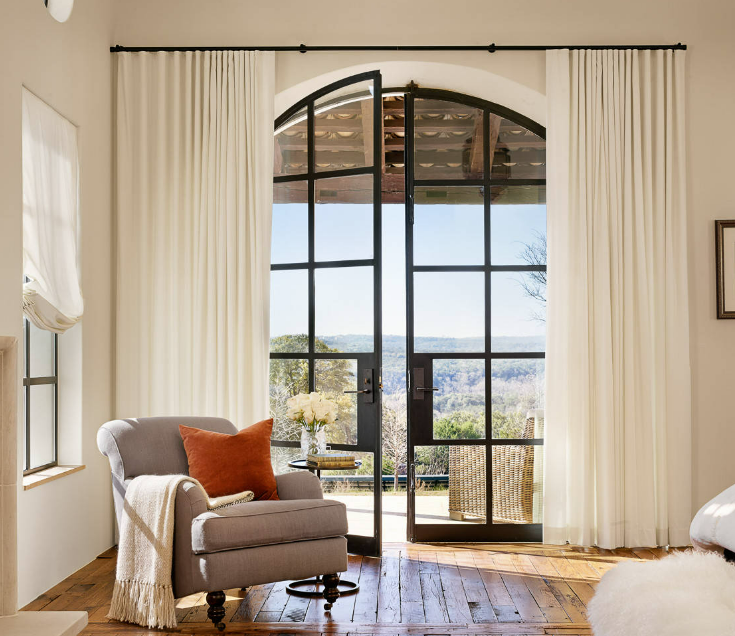
Mistake #1: Using Tension Rods on Operating Doors
Tension rods seem convenient but guarantee failure on French doors. The constant opening/closing creates pressure fluctuations that loosen the rod, causing it to slip or fall. Worse, the tension warps door frames over time—a client’s $200 custom door needed repair after a tension rod gouged the wood trim. Always use wall-mounted brackets screwed into studs. If mounting on drywall, use toggle anchors rated for 50+ pounds per bracket.
Mistake #2: Ignoring Curtain Stackback Space
Heavy drapes can stack back 12+ inches when fully open. If your rod doesn’t extend far enough, curtains obstruct the doorway. Calculate stackback: for two 54-inch panels, expect 18-24 inches of stacked fabric. Ensure your rod extends at least this far beyond the door frame. One homeowner’s elegant velvet curtains blocked 30% of their doorway because they didn’t account for this—forcing family members to squeeze past fabric mountains daily.
Mistake #3: Forgetting Ring or Clip Height in Length
Curtain rings add 1-2 inches of hidden length above the rod. Clip rings on tab-top curtains lift panels higher than expected. Always measure with your actual hardware: hang a test ring on the rod, then measure from there to the floor. A client’s “floor-length” curtains hovered 2 inches too high because they measured to the rod top instead of ring top—creating an awkward gap that collected dust bunnies.
Mistake #4: Not Measuring Each Door Panel Separately
Assuming both doors are identical causes crooked hangs. Older homes often have frames differing by 1/4 inch or more. Measure each door’s width and height individually, then use the larger measurement for ordering. One designer’s $800 custom curtains hung perfectly on the left door but gaped on the right because she measured only one side—a costly lesson in precision.
French Door Curtain Measurement FAQs: Expert Answers
Can I use a tension rod on French doors?
Absolutely not for operating doors. Tension rods slip during door movement and damage trim over time. The pressure required to hold heavy curtains warps wood frames. Use wall-mounted rods with brackets screwed into studs—this handles daily use without slippage. Tension rods only work on decorative French door windows that never open.
How do I measure for outward-swinging French doors?
The principle stays the same, but clearance zones expand. Measure the door’s swing arc outside—outward-swinging doors often need 2-4 extra inches of rod extension. Position holdbacks farther from the frame to ensure fabric clears the wider swing path. Always test with a fabric sample: open the door fully to confirm curtains won’t get pinned against exterior walls.
What’s the best fabric for French door curtains?
Choose lightweight to medium fabrics with good drape—linen, cotton blends, or polyester voile. Avoid stiff materials like heavy brocades that resist folding when doors open. For high-traffic areas, pick machine-washable fabrics since frequent operation increases dust exposure. Sheers work well for privacy without blocking light, while thermal-lined drapes improve energy efficiency.
How far should curtain rods extend past French door frames?
Minimum 6 inches per side for standard rooms. In kitchens or hallways with heavy traffic, extend 8-10 inches so curtains clear pathways. The rod must end beyond the door’s full swing arc—measure from frame to where the handle stops at 90 degrees, then add 2 inches. Proper extension ensures doors open fully without fabric obstruction and maximizes light when curtains are open.
How do I prevent curtains from getting caught in French doors?
Install holdbacks or tiebacks mounted 4+ inches beyond the door’s swing path. Position them at hip height for easy access. Choose magnetic or hook-style holdbacks that secure fabric firmly—not decorative tassels that slip. For double doors, use separate holdbacks per panel so you can open one door independently. Never let fabric drape within 6 inches of the closed door position.
Accurate measurements transform French door curtains from functional coverings into stunning focal points. By mapping swing zones first, calculating width for 2-2.5x fullness, and accounting for header drops in height, you’ll achieve that professional floor-kiss drape every time. Remember: measure each door panel individually, extend rods 6+ inches past frames, and always choose wall-mounted hardware over tension rods. With these techniques, your curtains will glide open smoothly while adding elegance to every room. Now that you’ve mastered measuring, focus on selecting easy-clean fabrics to maintain that fresh, tailored look through years of daily use.