That satisfying “thunk” when you close your car door? It’s missing. Instead, the outside handle sticks out awkwardly after opening, refusing to return to its flush position against the door. This common issue—door handle not returning to position—isn’t just an eyesore; it can snag clothing, collect debris, or even prevent proper latching. If you’re facing this problem, you’re not alone. Thousands of drivers deal with a sticking door handle every year, and the cause is usually fixable without a mechanic.
Understanding why this happens starts with the deceptively simple mechanism inside your door. When you release the handle, a small return spring should snap it flush against the body. When that spring fails or the linkage binds, the handle hangs limply. This guide cuts through the confusion with actionable steps to diagnose and repair the problem yourself. You’ll learn to pinpoint whether it’s a broken spring, corroded pivot, or bent rod—and fix it with basic tools in under an hour.
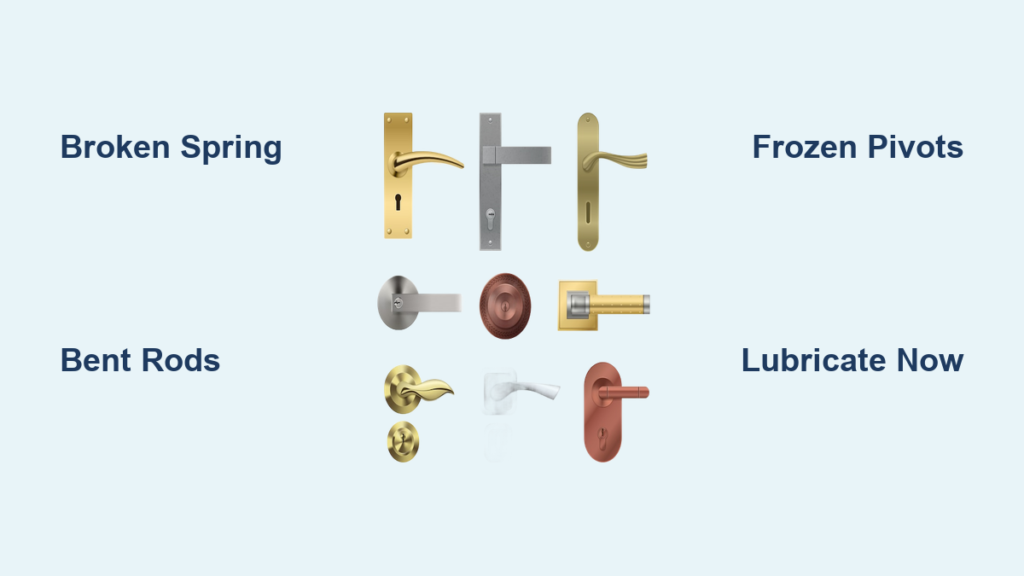
Broken Return Spring: The #1 Cause of Sticking Door Handles

Your car’s door handle relies on a tightly wound return spring to snap back into position after use. This tiny coil endures thousands of cycles annually, leading to fatigue, corrosion, or complete fracture. When the spring loses tension or snaps, the handle has no force pulling it flush. You’ll notice it sagging outward immediately after release, often with a weak “thud” instead of a crisp snap.
How to Confirm a Failed Return Spring
Inspect the mechanism through the door’s access holes while operating the handle. Look for:
– Visible gaps where the spring should anchor between the handle pivot and door frame
– Rust flakes or corrosion around the spring housing
– A disconnected spring end dangling freely
If the handle moves smoothly but won’t retract, the spring is almost certainly broken. Replacement takes 20 minutes and costs under $10 for the part.
Bent Linkage Rods: Why Your Handle Snags Mid-Motion
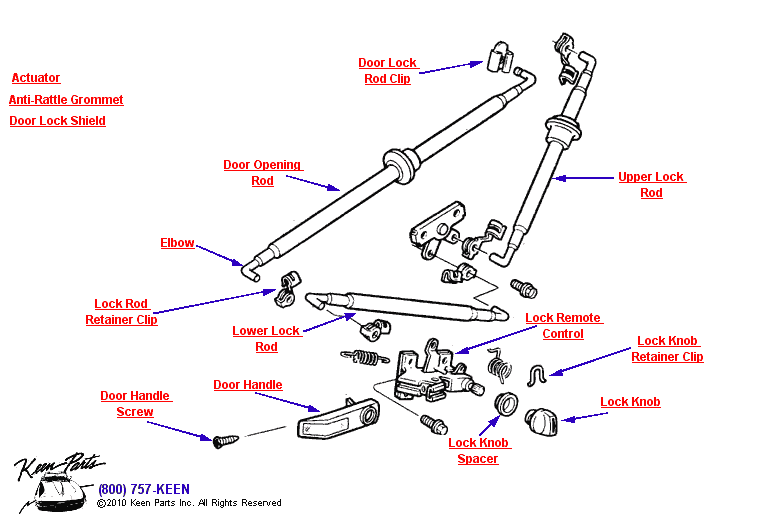
Bent metal rods connecting the handle to the latch mechanism create friction that prevents smooth retraction. This often happens after minor door impacts or improper handle use. Symptoms include the handle sticking at a 45-degree angle or requiring a “jiggle” to release.
Diagnosing Rod Misalignment
With the interior panel removed:
1. Operate the exterior handle slowly while watching the linkage
2. Note where resistance occurs—bends typically happen near plastic clips
3. Check for cracked or missing retaining clips that allow rods to shift
If rods rub against metal brackets instead of moving freely in their channels, straightening is required.
Frozen Pivot Points: When Corrosion Kills Handle Movement
Moisture and road salt corrode the handle’s pivot points—the small hinges where it rotates against the door. Without lubrication, metal-on-metal friction locks the handle in place. This causes gradual worsening: first occasional sticking, then constant failure to return.
Quick Fix for Stiff Pivots
Spray silicone lubricant (never WD-40—it attracts dust) onto pivot points while working the handle:
– Apply 2-3 short bursts directly into visible gaps
– Work the handle 10-15 times to distribute lubricant
– Wipe excess to prevent dirt buildup
Pro Tip: If stiffness returns within weeks, disassemble for deep cleaning—corrosion may be advanced.
Essential Tools for Door Handle Repair (No Special Equipment Needed)
You don’t need a mechanic’s toolbox for this fix. Gather these before starting:
– Phillips and flat-head screwdrivers (for panel screws and prying)
– Plastic trim removal tools ($5 kit prevents door panel damage)
– 10mm socket wrench (for most door latch bolts)
– Replacement return spring (confirm fitment using your VIN)
– Silicone spray lubricant (for pivots and linkages)
– Magnetic parts tray (holds tiny springs and screws securely)
Avoid metal pry bars—they crack plastic panels. Use a credit card edge for initial clip release.
Step-by-Step: Removing Your Interior Door Panel Without Breaking Clips
Damaged clips are the #1 DIY mistake. Follow this sequence:
1. Remove visible screws (armrest, door pull, speaker grille)
2. Slide a plastic tool under the panel’s bottom edge
3. Gently twist to release bottom clips (listen for soft “pops”)
4. Work upward along sides, avoiding the window channel
5. Lift the panel upward (not outward) to clear the window ledge
Critical: Disconnect the battery first to prevent accidental window activation. If your panel has wiring harnesses, unplug them before full removal.
Locating and Replacing a Broken Door Handle Return Spring
This 15-minute fix solves 80% of sticking handle cases:
1. Identify the spring—it’s a small coil attached to the handle pivot arm
2. Use needle-nose pliers to unhook the broken end from its anchor post
3. Stretch the new spring just enough to hook both ends (over-stretching ruins tension)
4. Test operation before panel reinstallation—handle should snap back crisply
Pro Tip: Take photos at each step. Spring orientation varies by model—your 2015 Honda Civic’s spring mounts differently than a 2020 Ford F-150.
Correcting Bent Linkage Rods Without Part Replacement
Straightening rods avoids costly latch assembly replacements:
1. Locate the bend—usually near the plastic clip attachment point
2. Grip the rod firmly with pliers at the bend location
3. Apply gradual pressure in the opposite direction of the bend
4. Check alignment by moving the handle through full range
Replace cracked plastic clips with OEM equivalents—they’re $2 and prevent future misalignment.
Testing Your Repair Before Reassembly: Avoid Costly Mistakes
Never skip this critical verification:
– Operate the handle 20+ times while watching internal movement
– Confirm full retraction—measure gap between handle and door (should be ≤1/8 inch)
– Check latch engagement by closing the door repeatedly
– Test lock functionality if rods connect to the lock mechanism
If the handle sticks during testing, recheck spring tension and rod alignment. Rushing reassembly guarantees a second disassembly.
When to Call a Professional for Door Handle Repairs
DIY isn’t always the answer. Seek help if:
– Keyless entry wiring is exposed (risk of short circuits)
– The latch mechanism itself is frozen (requires specialized tools)
– You’ve broken 3+ door panel clips (new panels cost $100+)
– The handle won’t retract even after spring replacement (indicates deeper latch issues)
Warning: Ignoring a sticking handle risks complete failure. If the handle detaches while driving, you lose exterior access—a major safety hazard.
Preventing Future Door Handle Return Failures
Extend spring life with these simple habits:
– Apply silicone lubricant quarterly to pivot points
– Never force a stiff handle—address minor sticking immediately
– Clear ice/snow before operating handles in winter
– Avoid leaning on exterior handles when opening doors
A well-maintained return spring lasts 5+ years. The $5 lubricant spray prevents $200+ latch replacements.
Key Takeaways for a Snug-Fitting Door Handle
A door handle not returning to position always traces back to three core issues: broken springs, bent rods, or corroded pivots. The fix is almost always accessible with basic tools—no dealership visit needed. Start by diagnosing spring integrity through the door’s access holes before removing panels. If replacement is required, match the spring to your exact vehicle model using the VIN. Crucially, test movement thoroughly before reassembly to avoid repeating the process.
Ignoring this issue risks progressive failure: a sagging handle collects moisture that accelerates corrosion, eventually freezing the entire mechanism. But with 30 minutes of focused effort, you’ll restore that satisfying snap-back motion and prevent costly complications. For persistent problems after spring replacement, inspect the latch assembly—it may need professional attention. Keep silicone lubricant in your glovebox for quick seasonal maintenance, and your handles will operate smoothly for years.