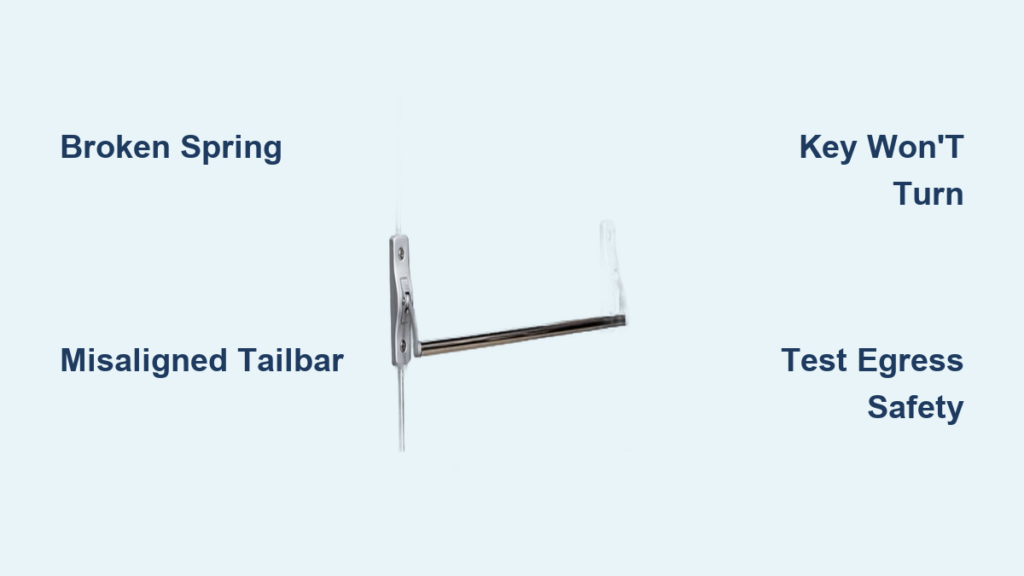
That sagging push bar handle on your commercial door isn’t just unsightly—it’s a serious safety hazard. When your panic bar handle droops downward instead of sitting horizontally, fails to lock properly, or won’t return to position after use, you’re dealing with more than an inconvenience. This common failure in mortise exit devices compromises security and violates fire safety codes that require immediate egress capability. Whether you’re managing a retail store, office building, or school facility, learning how to fix a push bar door handle could prevent costly emergency service calls and keep your property compliant.
Commercial doors with malfunctioning push bars present three critical symptoms you can’t ignore: a handle that hangs in a V-shape instead of horizontal, keys that turn partially but stop before fully engaging the lock, and doors that won’t secure properly. The good news is that 80% of these issues stem from just two mechanical failures—broken springs or misaligned components—that you can diagnose and repair yourself with basic tools. This guide delivers the precise steps to identify the root cause, implement effective repairs, and restore full functionality to your emergency exit hardware without unnecessary replacement costs.
Diagnosing Your Specific Push Bar Handle Failure Symptoms

Before grabbing tools, accurately identifying your exact problem saves hours of unnecessary disassembly. Push bar handle failures manifest in three distinct patterns that point directly to the underlying issue.
Why Your Push Bar Handle Droops Downward Instead of Staying Horizontal
A drooping handle that hangs at an angle rather than sitting perfectly horizontal almost always indicates a broken return spring—the most common failure point in commercial exit devices. As you press the push bar, this spring normally provides the tension that snaps the handle back to position. When it breaks or disengages, gravity takes over, creating that telltale V-shape. Check for this specific symptom: if the handle returns slowly or requires manual assistance to return to horizontal, your spring has likely lost tension or partially failed.
Troubleshooting When Your Key Turns Partially But Won’t Fully Lock
When your key inserts smoothly but stops turning before completing the locking sequence, you’re facing a cylinder or tailbar alignment issue. This specific failure pattern—where the key rotates about 270 degrees but won’t complete the final 90-degree turn—typically means the tailbar has slipped from its X-slot connection inside the mechanism. Don’t mistake this for a faulty lock cylinder; the problem usually lies in how the cylinder connects to the internal push bar mechanism rather than the lock itself.
Identifying Internal Component Failures Without Full Disassembly
You can often diagnose deeper mechanical issues through strategic testing before removing any components:
- With the door open, press the push bar and immediately release it—does it return crisply or drag back?
- Insert your key and turn while observing the exterior trim—does it wobble excessively?
- Operate the mechanism while listening for unusual sounds—clicking indicates disengaged parts while grinding suggests worn components
These simple tests reveal whether you’re dealing with a spring issue, alignment problem, or more serious internal damage requiring professional intervention.
Essential Tools and Safety Preparations for Push Bar Repair

Gathering the right equipment before starting prevents mid-repair frustrations and ensures safe handling of commercial exit hardware.
Must-Have Tools for Push Bar Handle Repair
Your toolkit needs these specific items to avoid stripping security screws or damaging components:
– Phillips and flathead screwdrivers (include a #2 Phillips for most commercial units)
– Hex key set (metric and standard—many devices use 2.5mm and 3mm)
– Needle-nose pliers (for spring manipulation without scratching components)
– Torx bit set (T15 and T20 are most common in modern exit devices)
– Magnetic parts tray (critical for keeping tiny components organized)
Critical Safety Steps Before Disassembly
Commercial exit devices are life-safety equipment—never compromise egress functionality during repairs:
– Test emergency function first: Verify the door still opens freely by pushing the bar before disconnecting anything
– Work with a partner: Have someone monitor the door while you test mechanisms
– Remove electrical connections: If your device has alarm contacts or electric latch retraction, disconnect power at the source before proceeding
– Document everything: Take photos at each disassembly stage—modern exit devices have precise component orientations
How to Fix a Broken Return Spring in Your Push Bar Handle
This step-by-step process addresses the most common cause of drooping handles—failed return springs—without requiring full mechanism replacement.
Accessing the Internal Spring Mechanism Safely
- Remove the interior trim plate by locating and unscrewing all visible fasteners (typically 2-4 screws)
- Carefully note the position of any shims or spacers—place them in your magnetic tray in exact removal order
- Gently pull the trim assembly away from the door while supporting the push bar mechanism
- Take a photo showing all components before proceeding—this prevents reassembly errors
Identifying and Replacing the Failed Spring Component
Inside the mechanism, locate these critical spring elements:
– Torsion springs (coiled tightly around pivot points)
– Compression springs (pushing against connecting rods)
– Spring cartridges (self-contained units in newer models)
For broken springs:
– Match replacement parts exactly—spring tension varies by manufacturer
– Use needle-nose pliers to carefully remove broken fragments
– Install new spring following manufacturer tension specifications (usually 15-20 degrees past neutral position)
For disengaged springs:
– Wear safety glasses—springs under tension can snap violently
– Use pliers to reseat the spring end into its mounting hole
– Test tension by manually moving the push bar through its full range
Reassembly and Critical Function Testing
After spring replacement:
1. Reinstall components in reverse order of removal
2. Before tightening all screws, test the push bar action 10-15 times
3. Verify the handle returns to horizontal within 1 second of release
4. Check for smooth operation without binding or grinding
5. Only after perfect function, secure all fasteners and reinstall trim plates
Fixing Cylinder and Tailbar Misalignment Issues

When your key won’t turn fully to engage the lock, this specialized repair addresses the cylinder-to-mechanism connection.
Locating and Reconnecting the X-Slot Tailbar Interface
- Remove the lock cylinder by inserting the key and turning to the removal position
- Inspect the tailbar (the square shaft extending from the cylinder)
- Check the X-shaped slot inside the mechanism where the tailbar connects
- If disconnected, align the tailbar with the slot and push firmly while rotating slightly
Adjusting Cylinder Depth for Proper Engagement
Many alignment issues stem from incorrect cylinder depth:
– If the key turns too freely, the cylinder sits too shallow—adjust the mounting ring deeper
– If it binds immediately, the cylinder sits too deep—back it out slightly
– Ideal position allows full rotation with consistent, moderate resistance
Testing Lock Function Without Door Closure
Before reinstalling trim:
– Operate the lock mechanism manually using the tailbar
– Verify full extension and retraction of the latch bolt
– Confirm the push bar action remains smooth with lock engaged
– Cycle the mechanism 20 times to ensure consistent performance
When to Skip DIY Repair and Call a Professional
Certain situations demand specialized expertise to maintain fire code compliance and safety.
Fire Code Compliance Red Flags
Stop repairs immediately if you notice:
– Modified components (welded parts or non-OEM replacements)
– Missing certification labels (UL, ANSI, or fire rating marks)
– Electrical integration issues (alarm contacts or electric latch retraction)
These indicate potential code violations that only certified technicians should address.
Cost-Effective Replacement Triggers
Consider professional replacement rather than repair when:
– Multiple components show simultaneous wear
– Your model is discontinued with limited parts availability
– Repair costs exceed 60% of a new mechanism
– You lack specialized tools for precision alignment
Commercial exit devices that fail to meet current fire codes (typically updated every 3 years) often require complete replacement rather than repair to maintain compliance.
Preventing Future Push Bar Handle Failures Through Proper Maintenance
A simple maintenance routine prevents 90% of common push bar failures and extends hardware lifespan.
Quarterly Maintenance Protocol
- Clean mechanism: Use a soft brush to remove dust and debris from all moving parts
- Lubricate strategically: Apply dry graphite lubricant only to pivot points and latch bolt (never oil-based products)
- Test operation: Cycle the push bar 25 times while checking for smooth action
- Verify alignment: Ensure handle returns to exact horizontal position within 1 second
Annual Professional Inspection Checklist
Schedule certified technician service annually to:
– Measure spring tension with calibrated gauges
– Check for microscopic cracks in metal components
– Verify strike plate alignment with door frame
– Test emergency egress force requirements (must open with ≤15 pounds of pressure)
By implementing these proven repair techniques and maintenance protocols, you’ll transform that drooping, malfunctioning push bar handle into reliable, code-compliant emergency hardware. Remember that proper spring tension and precise component alignment solve most push bar door handle issues—saving you the unnecessary expense of full replacement. For ongoing reliability, establish that quarterly maintenance routine and document each service to track component wear patterns before they become critical failures. When in doubt about fire code compliance or complex internal mechanisms, always consult a certified commercial door specialist to ensure your exit devices meet life-safety requirements.