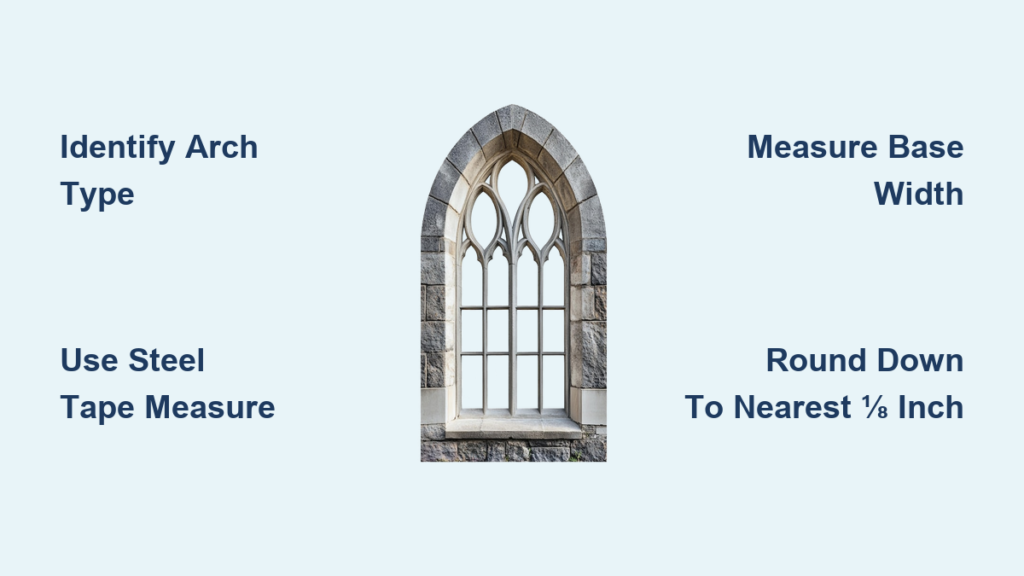
Measuring arched windows for blinds often feels intimidating, especially when the shape isn’t a standard rectangle. Getting accurate dimensions is critical because most arched window coverings must be custom ordered. If you’ve been searching for how to measure arch window openings correctly, this guide breaks down each arch style and shows you exactly what to do.
Below, you’ll learn how to identify your arch type, which tools to use, the exact measurements to take, and when to call a professional for help. Whether you’re shopping for cellular shades, pleated blinds, or specialty coverings, precise dimensions are the foundation of a flawless fit.
Identify Your Arch Type Before Measuring
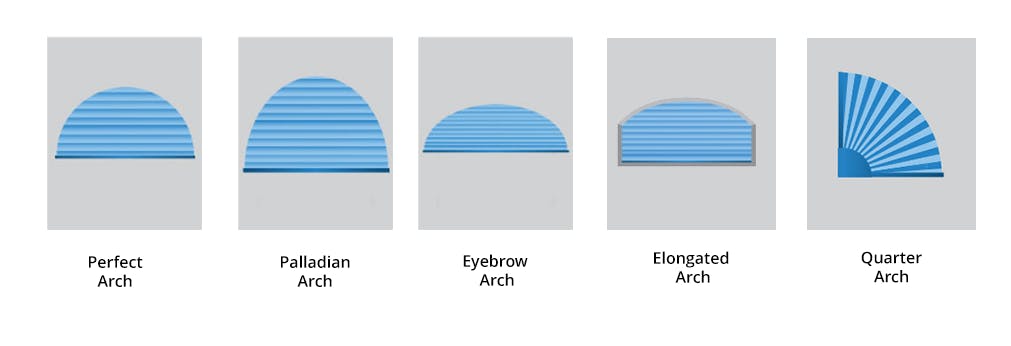
The shape of your window determines how you measure it and whether you can order online. Take a moment to figure out which category your arch falls into before pulling out the tape measure.
Perfect Arch: Height Equals Half the Width
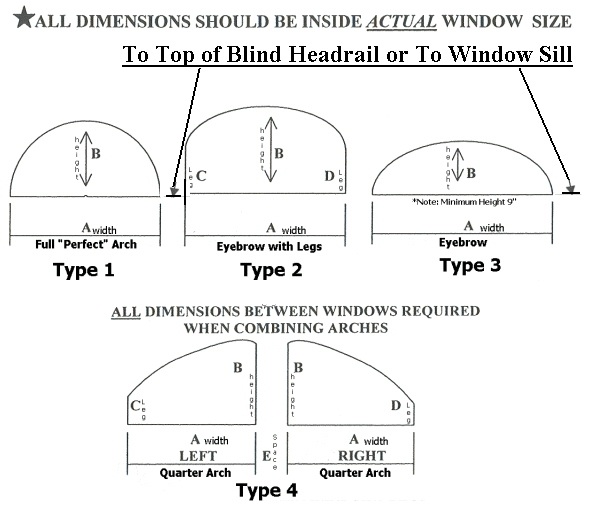
A perfect arch forms a clean semicircle where the height is exactly half the width at the base. This shape is common in both modern and traditional homes.
- Measure the full width across the bottom of the arch
- Measure the height from the base to the top center
- If the height equals half the width, you have a perfect arch
Perfect arches qualify for online ordering, which makes the process faster and easier.
Quarter Arch: Width and Height Must Match
A quarter arch is essentially half of a perfect arch. It forms a right angle with the curved section running diagonally across from the corner.
- Measure the vertical height from base to top
- Measure the horizontal width from edge to edge
- For a perfect quarter arch, both measurements must be identical
If your dimensions don’t match exactly, you’ll need a paper template and professional assistance.
Palladian Arch: Taller Than Half the Width
A Palladian arch has a height greater than half the width, creating a stretched, steeper curve. This style adds elegance but requires custom fitting.
- Measure the width at the base from side to side
- Measure the height from the base to the peak
- Palladian arches are typically non-perfect and require a template
Eyebrow Arch: Shorter Than a Perfect Arch
An eyebrow arch has a gentle, flattened curve resembling a raised eyebrow. The height is less than half the width.
- Measure the base width from left to right
- Measure the height from the base to the highest point
- Shallow curves make precision especially important
Eyebrow Arch with Legs: Four Measurements Required
Also called an elongated arch, this style includes vertical sides (legs) before the curve begins. It requires four separate measurements.
- Base width across the bottom
- Leg height from base to where the curve starts
- Total height from base to the peak
- Curve width at the top of the legs
These windows often need inside mounting, so confirm your window depth before ordering.
Gather the Right Measuring Tools
Using proper tools prevents costly errors. A few minutes of preparation saves time and money down the road.
Use a Steel Tape Measure Only
Cloth and plastic tape measures stretch and sag, leading to inaccurate readings. A steel tape measure offers the rigidity needed for precise work.
- Extend the tape smoothly across the opening
- Hold it taut without stretching or bending
- Read the measurement at eye level to avoid parallax errors
Keep Paper and a Pencil Handy
Write down every measurement immediately. Don’t rely on memory, especially when ordering custom products.
- Use a notepad or dedicated measurement form
- Label each measurement by arch type and room location
- Include units (inches) and any notes about the window
Take Precise Width and Height Measurements
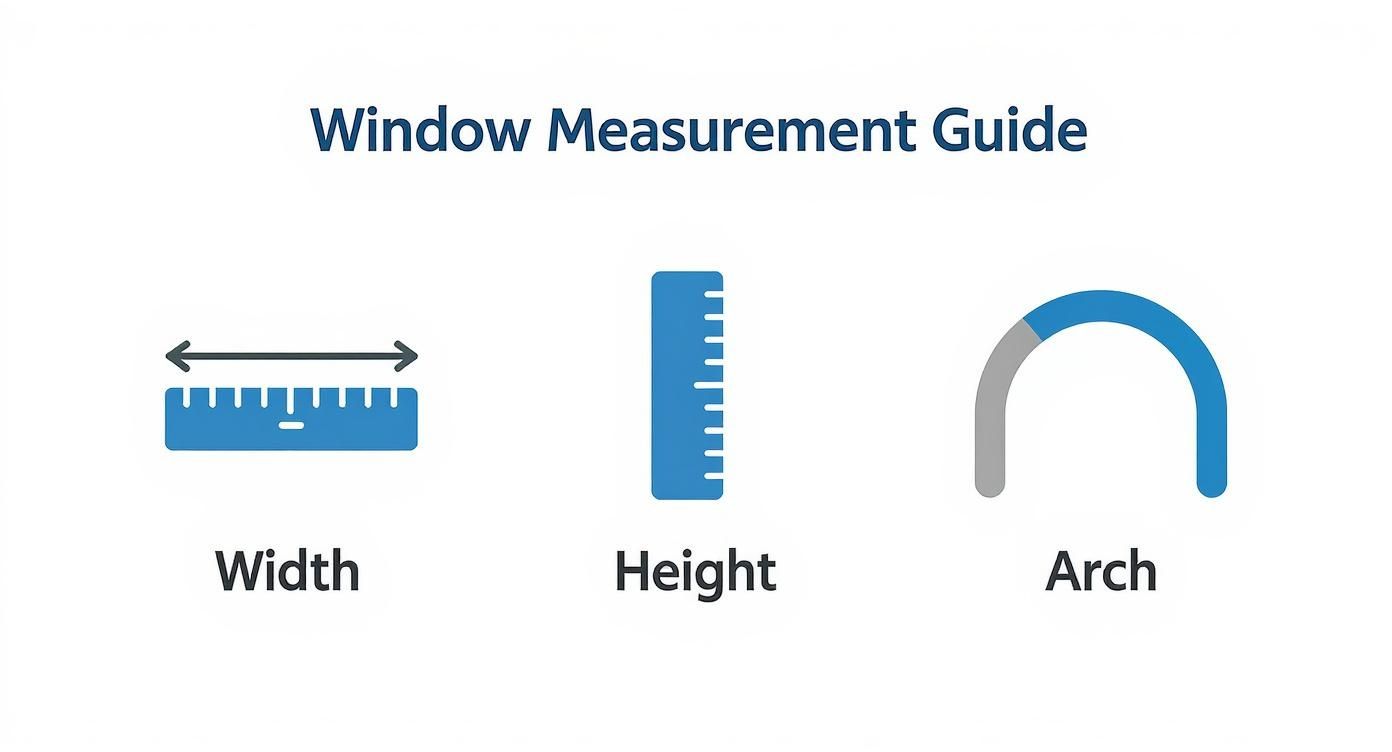
Once you know your arch type and have the right tools, you’re ready to measure. Follow these steps carefully.
Measure Width at the Base
For every arch style, measure the width from left to right at the bottom of the opening.
- Take the measurement at the narrowest point if the base isn’t level
- For inside mounts, measure edge to edge inside the frame
- For outside mounts, decide how much overlap you want beyond the frame
Measure Height to the Peak
Find the highest point of the arch and measure vertically from the base to that peak.
- Use a level to keep your measuring line straight
- For eyebrow and Palladian arches, double-check center alignment
- Record leg height and total height if your arch has vertical sides
Round Down to the Nearest ⅛ Inch
If your measurement lands between standard increments, always round down.
- Example: 36 ³⁄₁₆ inches becomes 36 ¼ inches
- Rounding down prevents blinds from being too wide or tall
- Never round up, even if the measurement seems close
Check Mounting Requirements Before Ordering

Even perfect measurements fail if the mounting setup doesn’t work. Confirm these details before placing your order.
Confirm Inside Mount Depth
Most arched blinds are inside mounted, which requires adequate window recess depth.
- Minimum depth for standard inside mount: 1 ½ inches
- Minimum depth for fully recessed fit: 2 ¼ inches
- Measure from the glass to the outer trim or wall
If your window lacks sufficient depth, consider an outside mount with side returns.
Verify the Mounting Surface
Arched windows often sit above other windows or in tricky locations. Make sure the base can support the blind’s weight.
- Use a stud finder or tap the surface to check for solid backing
- Most arches are bottom mount only, so weak surfaces may need reinforcement
- Check for obstructions like handles, trim, or nearby furniture
Know When to Call for Professional Help
Some arches can’t be measured with a tape measure alone. Knowing when to ask for help protects your investment.
Non-Perfect Arches Need a Paper Template
If your arch doesn’t meet perfect proportions (height doesn’t equal half the width for a perfect arch, or width doesn’t equal height for a quarter arch), it’s considered non-perfect.
- Online ordering isn’t available for irregular shapes
- You’ll need to create a paper template of the opening
- Call 800-575-8016 to request template instructions
Complex Shapes Require Expert Review
Elongated arches, off-center curves, and multi-segmented windows aren’t suited for self-measured orders.
- Design Consultants assess feasibility and guide you through options
- They help with template submission and material choices
- Avoid guesswork by getting professional input first
Choose Compatible Window Coverings

Once you have accurate measurements, you can select the right product for your arch.
Cellular Shades for Energy Efficiency
Honeycomb shades offer insulation and soft light filtering, making them popular for arched windows.
- Available online for perfect arches only
- Side mounts available upon request (not for arches over 40 inches wide)
- Ensure 1 ½ inch minimum depth for inside installation
Pleated Shades for Shallow Arches
Pleated shades are lightweight and work well in windows with limited depth.
- Same size and mount restrictions as cellular shades
- Request side mounting if inside depth is limited
- Cordless options offer safety and clean aesthetics
Angle Tops for Non-Arched Angled Windows
If your window is angled but not truly arched, angle top blinds may be the solution.
- Not suitable for true arches
- Best for trapezoidal or sloped-top windows
- Measured differently, so call for guidance
Avoid These Common Measuring Mistakes
Even experienced DIYers make errors when measuring arched windows. Watch out for these pitfalls.
Misidentifying the Arch Type
Calling a Palladian arch a perfect arch leads to incorrect measurements and poor fit.
- Double-check proportions before measuring
- Use the half-width rule as a quick test
- When in doubt, take photos and call for verification
Measuring to the Wrong Height Point
Some people measure only to the start of the curve instead of the peak.
- Always measure to the top center of the arch
- Include legs in total height if your arch has vertical sides
- Use a laser level for tall or high-mounted windows
Ignoring Mounting Constraints
Perfect measurements still fail if the mount isn’t feasible.
- Check for obstructions like handles, trim, or furniture
- Confirm clearance for blind operation
- Outside mounts may need extra width for proper overlap
Frequently Asked Questions About Measuring Arch Windows
What tools do I need to measure an arch window?
You need a steel tape measure, paper, and a pencil. Steel tape measures provide the rigidity and accuracy needed for precise measurements. Cloth and plastic tapes stretch too easily and lead to errors.
How do I know if my arch is perfect or non-perfect?
Measure the width at the base and the height from base to peak. For a perfect arch, the height must equal exactly half the width. For a perfect quarter arch, the height and width must be identical. If those proportions don’t match, your arch is non-perfect.
Can I order blinds for arched windows online?
Yes, but only for perfect arches and perfect quarter arches. Non-perfect arches, Palladian arches, eyebrow arches with legs, and irregular shapes require a paper template and must be ordered by phone at 800-575-8016.
What is the minimum depth for inside mount arched blinds?
The minimum window opening depth for a standard inside mount is 1 ½ inches. If you want the blind fully recessed with no protrusion, you need at least 2 ¼ inches of depth.
Should I round measurements up or down?
Always round down to the nearest ⅛ inch. Rounding up can result in blinds that are too wide or too tall to fit properly. For example, 36 ³⁄₁₆ inches becomes 36 ¼ inches.
Do cellular and pleated shades work for wide arches?
They work for arches up to 40 inches wide. For wider arches, side mounts aren’t available, and you may need to explore other options or call for custom guidance.
Key Takeaways for Measuring Arch Windows Successfully
Measuring an arch window becomes manageable when you break it into clear steps. Start by identifying your arch type, since this determines whether you can order online or need a paper template. Use a steel tape measure for accuracy, and always round down to the nearest ⅛ inch to ensure a proper fit.
Before ordering, confirm your window has at least 1 ½ inches of depth for inside mounting, and verify the base surface can support the blind’s weight. If your arch is non-perfect, complex, or elongated, skip the guesswork and call 800-575-8016 to speak with a Design Consultant.
Ready to order? Grab your steel tape measure, identify your arch type, and record your dimensions carefully. With accurate measurements in hand, you’ll be one step closer to beautiful, custom-fitted blinds that enhance both the look and function of your arched windows.