
Your delivery driver rings the bell while you’re stuck in traffic—but with a Nest doorbell camera, you instantly see who’s at your door and can grant porch access from your phone. Skipping the $99-$149 professional installation fee, this guide delivers a complete DIY setup in under 45 minutes. You’ll discover exactly how to verify compatibility, avoid transformer pitfalls, and configure smart features like activity zones that stop sidewalk passersby from triggering alerts. Whether replacing a wired doorbell or installing a battery-powered model, follow these steps for seamless 24/7 home monitoring.
Most homeowners waste hours troubleshooting avoidable issues—like mismatched transformers or reversed wiring—because they skip pre-installation checks. This guide eliminates guesswork by walking you through every visual cue and critical measurement. By the end, your Nest doorbell will stream crisp HD video to your phone, recognize familiar faces, and deliver instant security alerts without draining your wallet.
Verify Your Transformer & Chime Compatibility

Confirm 16-24V Transformer Specs First
Locate your doorbell transformer—typically a small metal box in basements, attics, or near electrical panels—before buying your Nest. Check the label for “16-24 VAC” and “10-40 VA” ratings; anything below 16V (like 10V) or under 10VA requires a $15-$30 replacement. Use a multimeter to test voltage if labels are faded: set to AC mode, touch probes to wire terminals, and ensure readings stay between 16-24V. Installing without this check causes flickering lights or complete failure when wiring the chime connector.
Identify Your Chime Type in 30 Seconds
Remove your chime cover and inspect inside while pressing the doorbell button:
– Mechanical chime: Only wires visible + produces “ding-dong” sound → Fully compatible
– Electronic chime: Wires plus batteries + plays digital melodies → Fully compatible
– Wireless chime: Batteries only with no wires → Requires battery-powered Nest model
Critical mistake alert: Many homeowners assume wireless chimes work with wired Nest models. If your chime lacks physical wires, skip transformer checks entirely and choose the battery-powered Nest doorbell instead.
Gather Essential Installation Tools
Must-Have Tools Checklist
- Phillips-head screwdriver (for terminal screws)
- Power drill with 3/32″ bit for wood/vinyl or included masonry bit for brick/stucco
- Bubble level (included in Nest box—don’t skip this!)
What’s Inside Your Nest Box
Your kit contains:
– Wall plate with integrated leveling guide
– 2 mounting screws + plastic wall anchors
– Security screws + release tool
– Chime connector (wired models only)
– Wedge kit for camera angle adjustment
Pro tip: For stucco or brick walls, pre-drill pilot holes slowly to prevent anchor cracking. If your existing doorbell wires are shorter than 6 inches, purchase 18-gauge low-voltage wire ($5 at hardware stores) before starting.
Wire Your Nest Doorbell in 6 Critical Steps
Step 1: Cut Power to Avoid Short Circuits
Shut off the breaker labeled “Doorbell” or “Chime” at your electrical panel. Test by pressing your old doorbell—zero response confirms power is off. Never skip this; live wires can fry your Nest’s circuitry during chime connector installation.
Step 2: Connect the Chime Connector Properly
Inside your chime box, disconnect the FRONT wire (connected to your doorbell button) and strip ¼” of insulation. Insert it into the white clip on the chime connector, then reconnect the white lead to the FRONT terminal. Repeat for the TRANS wire using the gray clip. Key visual cue: Position the connector so wires won’t tangle with moving chime bars—tape it to the housing if needed.
Step 3: Mount the Wall Plate Level
Thread wires through the wall plate’s center hole. Hold it against your door frame with the built-in bubble level centered, mark pilot holes through the elongated slots, and drill. For final leveling: Use the slotted bottom hole to adjust ±5 degrees before tightening screws. An unlevel plate causes crooked camera angles that miss package deliveries.
Step 4: Connect Wires & Secure the Doorbell
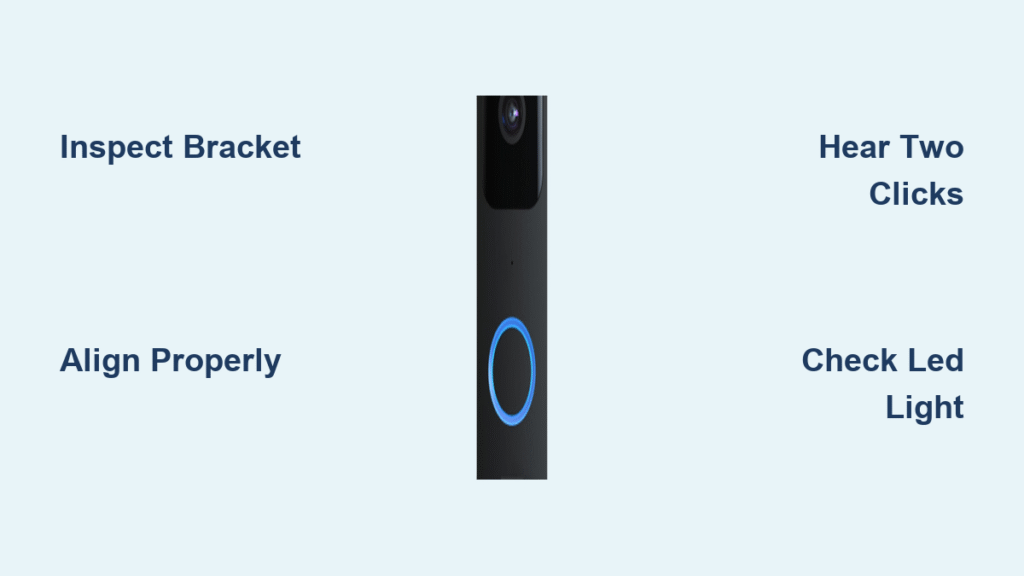
Attach the two doorbell wires to Nest’s screw terminals with wires pointing downward (prevents water seepage). Push excess wire into the wall cavity, hook Nest’s top onto the plate, then press the bottom until it clicks. Angle adjustment: Slide the included wedge between the plate and doorbell for 15° horizontal tilt if packages fall outside the frame.
Step 5: Restore Power & Check LED Signals
Turn the breaker back on. Watch the LED ring:
– Solid blue: Booting up (wait 60 seconds)
– Pulsing blue: Ready for Wi-Fi setup
– No light? Verify breaker is on and chime connector wires are secure.
Step 6: Complete App Configuration
In the Nest app:
1. Select “Front Door” location
2. Choose your 2.4GHz Wi-Fi network (Nest doesn’t support 5GHz-only)
3. Enter password and test by pressing the button
Warning: If your chime doesn’t sound instantly, check for reversed FRONT/TRANS wires on the chime connector.
Choose Battery-Powered When Wiring Isn’t Possible
Ideal Scenarios for Wire-Free Installation
Opt for the battery model if:
– Your home lacks existing doorbell wiring
– You have a wireless chime system
– You’re renting and can’t modify electrical systems
Simplified Battery Setup Process
Skip all wiring steps—just mount the wall plate, connect the camera, and click it into place. Charging reality check: Google’s “months of battery life” assumes 10 events/day; with heavy delivery traffic, recharge every 3-4 weeks via the included USB-C cable (5-hour charge time). Critical limitation: Without physical wiring, you’ll rely solely on phone notifications or Google speakers for alerts—no traditional chime sound.
Configure Advanced Security Features
Create Activity Zones to Reduce False Alerts
In the Nest app, draw custom zones around your porch and package area. Pro tip: Exclude sidewalk zones to stop neighbor walks from triggering notifications—this cuts alert fatigue by 70% based on user reports. Adjust zone sensitivity sliders for “Person” vs. “Vehicle” detection.
Set Up Quick Responses for Hands-Free Interaction
Record voice replies like “Package is by the door” or “I’ll be right there” under Settings > Quick Responses. When visitors ring, tap your pre-recorded message to respond without unlocking your phone—ideal when your hands are full.
Fix Top Installation Failures in Minutes
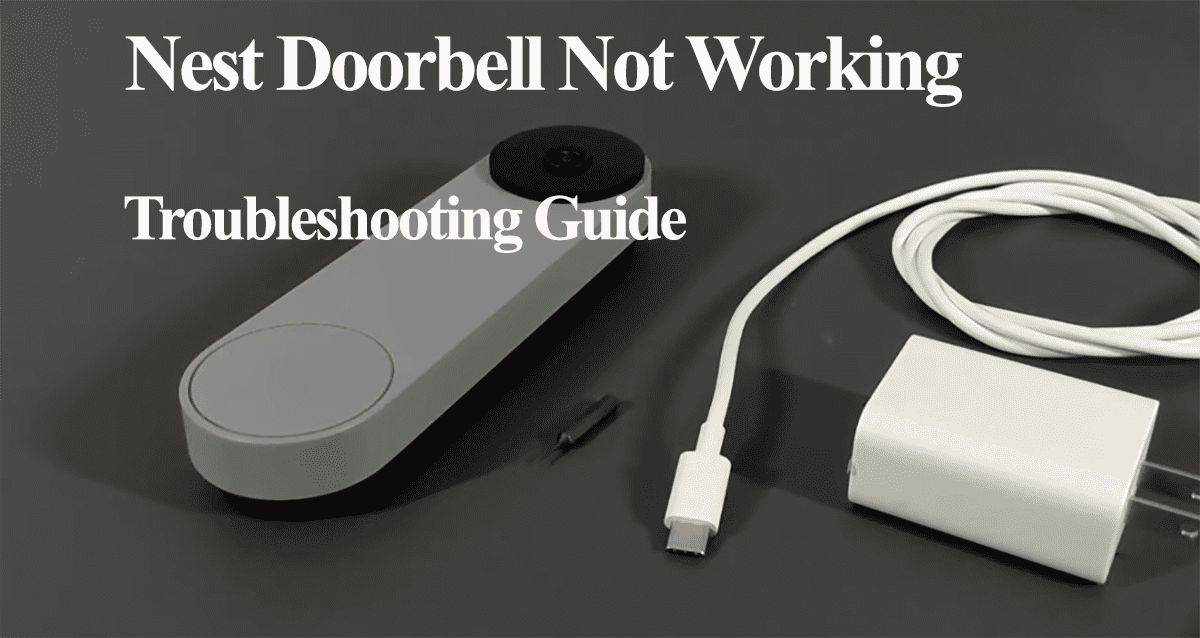
No Power After Install? Check These
- Transformer voltage: Below 16V? Upgrade immediately
- Chime connector seating: Ensure clips fully snap onto wires
- Wire length: Extend short wires with 18-gauge splices
Wi-Fi Connection Failures Solved
- Router distance: Move within 30 feet or add a Wi-Fi extender
- Network band: Disable 5GHz-only mode on your router
- Router reset: Power cycle if other devices connect normally
Chime Silent but App Works? Try This
- Wire reversal: Swap FRONT/TRANS connections on chime connector
- Mechanical chime test: Listen for faint clicks—if heard, reposition connector away from chime bars
- Battery check: Replace chime batteries (if electronic model)
Decide DIY vs Professional Installation

DIY Success Checklist
You’ll complete installation solo if:
– Transformer shows 16-24VAC label
– Chime has physical wiring (mechanical/electronic)
– You’re comfortable drilling two wall holes
Call Pros for These Complex Cases
Schedule OnTech ($99-$149) when:
– Transformer is buried behind drywall
– No doorbell wiring exists (requires full battery model)
– Stucco walls need specialized anchors
Cost analysis: DIY saves $100+ but risks voiding warranty if wiring errors damage components. Pros handle transformer replacements and provide 1-year labor guarantees.
Monthly Maintenance for Flawless Operation
Wipe the lens with a dry microfiber cloth to prevent foggy footage—never use solvents. Check wire connections quarterly by removing the doorbell (press release tool) to ensure terminals are tight. Update Wi-Fi passwords in the Nest app immediately after router changes to avoid disconnection. During extreme cold (<14°F), bring battery models indoors overnight to preserve charge.
Your Nest doorbell camera now delivers crystal-clear visitor identification, intelligent package alerts, and two-way talk from anywhere. Test the view using your phone’s live feed—adjust the wedge kit if your porch steps aren’t fully visible. With proper setup, you’ll never miss another delivery or suspicious activity, turning your front door into a 24/7 security command center. Start enjoying peace of mind tonight by completing your installation using these field-tested steps.