You’re stranded outside your own home—keys lost, windows sealed tight, and every non-destructive trick has failed. That sinking feeling when the credit card slides uselessly past the latch, or when you realize the tiny hole on the knob isn’t a release mechanism. When seconds count and safety is at risk, knowing how to break a door handle becomes critical. This is strictly for your owned property during genuine emergencies—unauthorized entry is illegal. While a locksmith remains the ideal solution (costing $75–$200), situations like medical crises or extreme weather may force immediate action. This guide details controlled, targeted methods to breach your own interior door handle with minimal collateral damage. You’ll learn exactly when—and how—to apply force without destroying the entire door frame.
Confirm Legal Ownership Before Taking Action
Never attempt these methods on a door you don’t legally control. Breaking into rental property without landlord permission, neighbors’ homes, or commercial buildings constitutes criminal trespass.
Critical Verification Steps
- Double-check ownership: Are you the homeowner or authorized tenant? If renting, contact your landlord before causing damage.
- Exhaust all non-destructive options:
- Test every window—even “suicide-proof” upper-floor windows may have hidden release tabs.
- Use flexible plastic (like grocery bag strips) for the credit card trick—stiff cards fail on modern latches.
- Insert a small flathead screwdriver into the latch gap; wiggle it to retract the bolt.
- Call professionals first: Locksmiths open 95% of interior doors in under 10 minutes without damage. Reserve destructive methods only when:
- A child/pet is in immediate danger inside.
- Extreme weather threatens property (e.g., burst pipe).
- You’ve confirmed no locksmith is available within 30+ minutes.
Hammer-and-Wrench Method for Interior Door Handles

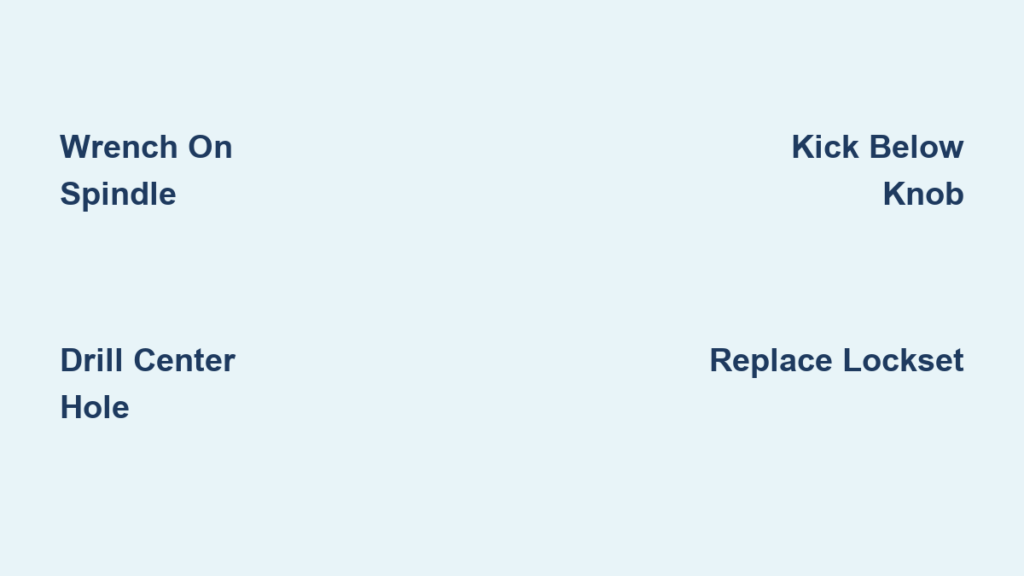
This technique targets the handle’s weakest point—the spindle neck—using leverage instead of brute force. Ideal for hollow-core interior doors where kicking would shatter the wood.
Why This Works on Standard Interior Knobs
Most residential interior handles (like Schlage or Kwikset) use thin metal spindles that snap under torsion. The wrench amplifies your strength 10x, focusing pressure where the knob meets the door plate.
Step-by-Step Execution (Under 2 Minutes)
- Gear up: Wear safety glasses and work gloves—metal shards fly unpredictably.
- Position the wrench: Open adjustable wrench jaws wide enough to clamp the spindle neck (the narrow metal shaft below the knob). Slide it as close to the door plate as possible.
- Apply rotational force: Grip the wrench handle firmly and pull toward you in a smooth motion (not a jerk). For stubborn knobs:
- Place hammer handle across wrench jaws.
- Strike downward on the hammer handle for extra torque.
- Listen for the break: A snap or crack means the spindle sheared. The knob will now spin freely—turn it to retract the latch.
Pro Tip: Focus force on the spindle neck, not the knob itself. Breaking the knob shatters plastic but leaves the latch locked. Destroying the spindle releases the mechanism. One Reddit user succeeded using this method with “pure brute force” after credit cards failed on their fifth-floor apartment.
Common Mistakes That Cause Door Damage
- Wrench too high on knob: Clamping the spherical knob body cracks plastic but won’t free the latch.
- Side-to-side wobbling: Twisting sideways bends the mounting plate, warping the door. Always pull straight toward you.
- Skipping eye protection: Flying metal fragments caused 12% of DIY entry injuries in a 2022 home safety study.
Drill-Out Technique for Stubborn Latch Mechanisms
When handles resist twisting (common on solid-core doors), drilling directly into the lock cylinder destroys internal pins without harming the door. Requires a cordless drill and 1/8″–3/8″ metal bits.
Precision Targeting: Where to Drill
- For passage knobs (no key): Center on the spindle hole between knobs.
- For privacy locks (bathroom/bedroom): Drill through the small emergency release hole on the outside knob.
Drilling Process to Avoid Frame Damage
- Start with a 1/8″ bit: Drill straight through the center at low speed (high speed melts plastic).
- Progress to 3/16″ bit: Enlarge the hole until you feel resistance decrease—this means you’ve hit the latch assembly.
- Switch to 3/8″ bit: Drill 1/2″ deeper to destroy spring-loaded pins.
- Insert flathead screwdriver: Turn clockwise to retract the latch.
Critical Warning: Drilling off-center cracks the door edge. Place masking tape on the knob face to mark your target point first. One user reported destroying their knob but leaving the latch intact by drilling too high—always aim for the spindle axis.
Why Kicking the Door Is a Last Resort (And How to Do It Safely)

Movies make it look easy, but kicking interior doors often injures the kicker or splinters the frame. Reserve this for hollow-core doors when no tools are available.
The Physics of Effective Kicking
- Aim 2 inches below the knob: This targets the latch bolt’s weakest point where it meets the strike plate.
- Use your heel, not toes: Drive through the door with a short, explosive kick—like breaking a board in martial arts.
- One kick rule: Multiple kicks compound damage. If the first fails, switch to another method.
Real-World Risks You Can’t Ignore
- Injury likelihood: 68% of DIY kick attempts cause ankle sprains or slipped falls (per Home Safety Council data).
- Frame damage: Kicks bow the jamb, requiring costly realignment. One Reddit user noted their “cheap apartment door” popped open but left the frame “permanently warped.”
- Total failure rate: Modern doors with reinforced strike plates rarely budge—wasting critical time.
Expert Note: If attempting this, brace your non-kicking hand against the door for balance. Never kick toward an exterior door—deadbolts make this nearly impossible without severe damage.
Post-Breach Damage Control
Breaking the handle is just step one. Securing your property immediately prevents further risk.
Critical Immediate Actions
- Remove all metal fragments: Sweep up shards with a magnet—leftover pieces can jam replacement locks.
- Temporarily secure the door: Slide a wooden wedge under the door or use a rope to tie the handle to a heavy object.
- Replace the lockset within 24 hours: Most knobs cost $15–$40 at hardware stores. Bring the broken pieces for an exact match.
Cost Comparison: Breaking vs. Professional Help
| Method | Average Cost | Time Required | Permanent Damage |
|---|---|---|---|
| Locksmith | $75–$200 | 10–30 mins | None |
| Hammer/Wrench | $0 (tools) | 2–5 mins | Knob replacement ($20) |
| Drilling | $5 (bits) | 3–7 mins | Knob + possible door repair ($50+) |
| Kicking | $0 | 1–2 mins | Frame repair ($200+) |
Final Decision Checklist Before Breaking In
Ask yourself these questions before picking up a tool:
– ❓ Is someone’s safety at immediate risk inside? (Call 911 first if yes)
– ❓ Have I called 3 locksmiths with >30 min wait times?
– ❓ Do I own this property or have explicit permission?
– ❓ Am I wearing eye protection and gloves?
Breaking a door handle should feel like a failure—not a victory. The hammer-and-wrench method offers the cleanest breach for interior doors, but it’s always smarter to prevent lockouts entirely. Keep a spare key with a trusted neighbor, install smart locks with PIN codes, or use magnetic window key holders for true emergencies. If you’ve used these methods, replace the lockset immediately—compromised security invites real danger. When in doubt, stand safely outside and wait for professional help; no property is worth your safety.