That frustrating moment when your hand instinctively reaches for a door handle only to find it sticky, awkward, or completely broken – it happens more often than you’d think. Choosing the right door handle impacts every interaction with your home, affecting daily convenience, security, and even your property’s visual harmony. With overwhelming options in design, function, and durability, skipping proper selection leads to mismatched aesthetics, premature failures, and security vulnerabilities. This guide cuts through the confusion so you can confidently how to choose a door handle that works flawlessly for years while elevating your space.
Most homeowners underestimate how much a handle influences room flow and safety. A poorly chosen lever on a front door might compromise security, while an ill-suited knob in a child’s room could create accessibility issues. You’ll learn to decode technical specs like backsets and door handing, match finishes to your decor, and prioritize features based on real-world use. By the end, you’ll transform from overwhelmed shopper to informed buyer – saving money on replacements and avoiding costly installation mistakes.
Door Purpose and Usage: Match Handle Strength to Traffic Flow
Your front door handle faces vastly different demands than a linen closet knob. High-traffic areas like main entrances or kitchen doors require heavy-duty construction to withstand constant use, while a guest bathroom handle can prioritize style over brute strength. Ignoring this mismatch leads to worn mechanisms and squeaky levers within months. Always assess how often the door operates and who uses it – toddlers, elderly relatives, or frequent visitors dramatically change your requirements.
Why Bathroom Handles Need Different Security Than Front Doors
Bathrooms demand privacy locks with emergency access features, while exterior doors require maximum security. Installing a passage knob on your front door creates dangerous vulnerabilities, whereas a privacy lock on a closet wastes money on unnecessary mechanisms. Identify each door’s primary function first: Is it for security (exterior), privacy (bedrooms/bathrooms), or pure access (closets/hallways)? This single step eliminates 70% of wrong choices before you even consider style.
Locking Mechanisms: Selecting the Right Security for Each Room

Choosing the wrong lock type causes daily frustration. A privacy lock in a hallway forces unnecessary unlocking, while a passage knob on a bedroom compromises safety. Your selection must align with the room’s purpose and building codes – especially for emergency access in private spaces.
Privacy Locks: Non-Negotiables for Bedrooms and Bathrooms
These handles lock from the inside (via push-button or twist knob) but feature universal emergency access – usually a pinhole accepting a flathead screwdriver. Never skip this feature in private rooms; it’s often required by safety codes for medical emergencies. Avoid “keyed” privacy locks unless you have specific security needs, as they create dangerous delays during crises.
Passage Knobs vs. Dummy Handles: When Locks Are Unnecessary
Closets, pantries, and connecting doors between bedrooms only need passage knobs (no lock) or dummy handles (no latch). Passage knobs operate the latch but can’t lock, while dummies are purely decorative pull points for non-latching doors like French doors. Installing full locks here wastes money and complicates installation with unnecessary internal mechanisms.
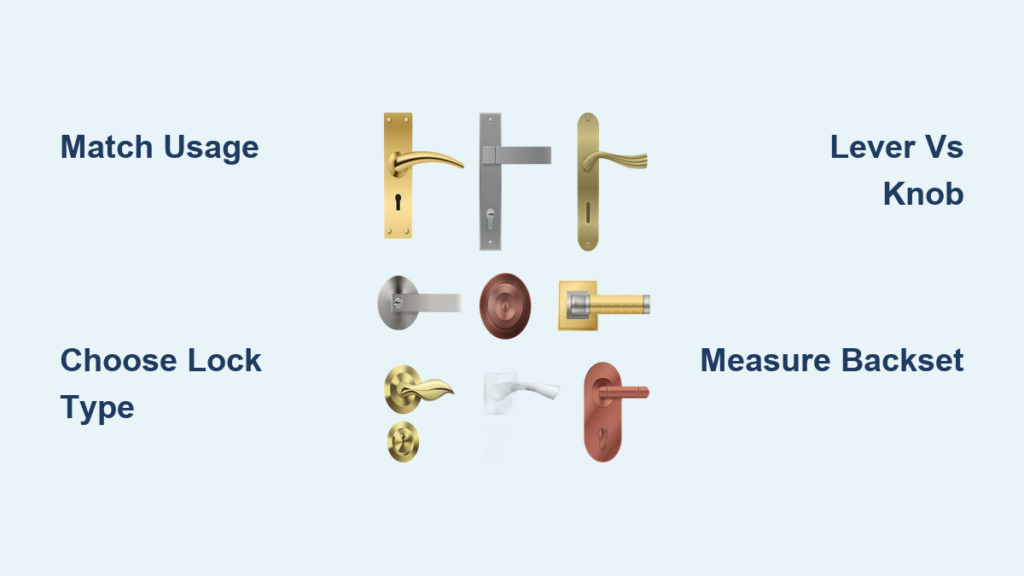
Opening Mechanisms: Lever vs. Knob vs. Pull for Real-World Use
Your hand’s natural movement determines comfort. Levers require only downward pressure, making them accessible for children, arthritis sufferers, or anyone carrying groceries. Knobs demand full grip rotation – problematic for limited dexterity. Pull handles excel on sliding doors or when hands are full but require more space to operate.
Why Levers Outperform Knobs for Accessibility
A lever handle’s simple push motion meets ADA standards and prevents daily strain. Test this yourself: Try turning a knob with your elbow versus pushing a lever – the difference becomes obvious when your arms are full of laundry. For main entry points or family bathrooms, levers are non-negotiable for true accessibility. Reserve knobs for low-traffic rooms where classic style outweighs ergonomic needs.
Material, Finish, and Style: Creating Cohesive Home Aesthetics
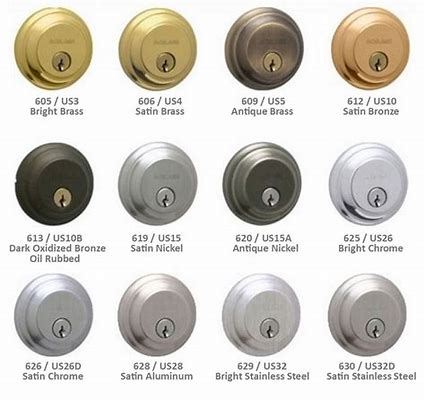
Mismatched finishes scream “afterthought.” Satin nickel on modern cabinets clashes with oil-rubbed bronze door handles, disrupting your home’s visual flow. Prioritize consistency across hardware – your faucet finishes should whisper the same story as your handles.
Finish Durability: Beyond Just Looks
Polished chrome shows every fingerprint and water spot, demanding constant cleaning. Satin nickel hides wear beautifully in high-use areas. Matte black maintains its modern edge but shows scratches more than metallic finishes. Oil-rubbed bronze develops a patina over time – loved by some, frustrating for others seeking “like new” permanence. Match the finish’s maintenance needs to the door’s location: high-moisture bathrooms need corrosion-resistant options like stainless steel.
Style Rules: Modern, Traditional, or Transitional?
Contemporary spaces demand clean-lined levers in matte black or brushed nickel – avoid ornate details. Traditional homes shine with curved knobs in antique brass or bronze. Transitional spaces blend eras: try a classic lever shape in matte black. Never choose handles based solely on door color; step back and consider your home’s architectural era and overall hardware theme.
Security and Safety: Non-Negotiables for Exterior Doors

Front door handles are your first security line. Flimsy mechanisms with visible screws invite break-ins. Always pair exterior handles with a separate deadbolt and verify ANSI/BHMA Grade 2 (or higher) security ratings. Cheap “Grade 3” hardware fails under pressure testing – a critical oversight during how to choose a door handle for entry points.
Child Safety Considerations You Might Overlook
Lever handles help toddlers operate doors but create hazards near stairs or pools. Install temporary lever locks (removable with a tool) as a stopgap until permanent solutions like door guards are fitted. For young children’s rooms, avoid privacy locks that require tools to open from outside – opt for passage knobs with separate childproofing.
Measuring and Installation: Avoid Costly Fitment Errors
The #1 installation mistake? Assuming standard measurements. Backset errors (distance from door edge to handle center) cause misaligned latches. Door handing mistakes (left vs. right swing) force you to buy replacement parts. Measure twice before purchasing – your old handle holds the answers.
Critical Measurements You Must Take
Grab a tape measure and record three numbers:
– Backset: 2-3/8″ or 2-3/4″ is standard in US homes – measure from door edge to center of existing latch hole
– Hole spacing: For lever-on-rose handles, measure between screw holes on the mounting plate (common: 2-3/4″, 4-1/2″, or 5-7/8″)
– Door handing: Stand outside the room. If hinges are on your left as the door opens away from you, it’s left-handed (and vice versa)
Most modern handles are reversible, but deadbolts often aren’t – confirm handing before buying exterior sets.
Finalizing Your Choice: 4 Steps to Confidence
Match the House, Not Just the Door
Your front door handle should harmonize with your home’s exterior style first – not just the door color. A Victorian home needs ornate brass, not matte black industrial pulls. Walk through your house and note existing hardware: do cabinet pulls match faucet finishes? Your door handles must join this visual conversation.
Prioritize Feel Over Photos
Online images lie about weight and operation. Visit a showroom to test handles. Lift the lever – does it move smoothly with no gritty resistance? Does the knob feel substantial, not hollow-plastic cheap? Your hand should confirm quality before your eyes decide on style.
Check the Hidden Mechanism Quality
Peer inside the handle’s rose plate. Solid brass or zinc mechanisms feel weighty and operate silently. Cheap handles use plastic internals that crack under pressure. Ask for warranty details: reputable brands offer 10+ years on mechanical parts, while budget options hide behind 1-year promises.
Invest in Longevity, Not Just Price
A $50 solid-brass handle outlasts three $15 plastic ones. Exterior handles face weather extremes – cheap finishes corrode, weak latches bend. Calculate cost-per-year: a $120 handle lasting 20 years costs $6/year versus a $25 handle replaced every 2 years ($12.50/year). For high-use doors, premium investment pays off in durability and peace of mind.
Choosing the perfect door handle balances form, function, and foresight. You now know how to decode technical specs, match hardware to real-world use, and avoid costly missteps. Remember to prioritize security on exterior doors, accessibility in family areas, and visual harmony throughout your home. The right handle disappears into daily life – smooth, reliable, and perfectly matched to your space. When you how to choose a door handle using these steps, you’re not just buying hardware; you’re investing in years of effortless, secure, and beautiful home interactions. Start measuring your problem doors today – your future self will thank you every time you turn the handle.