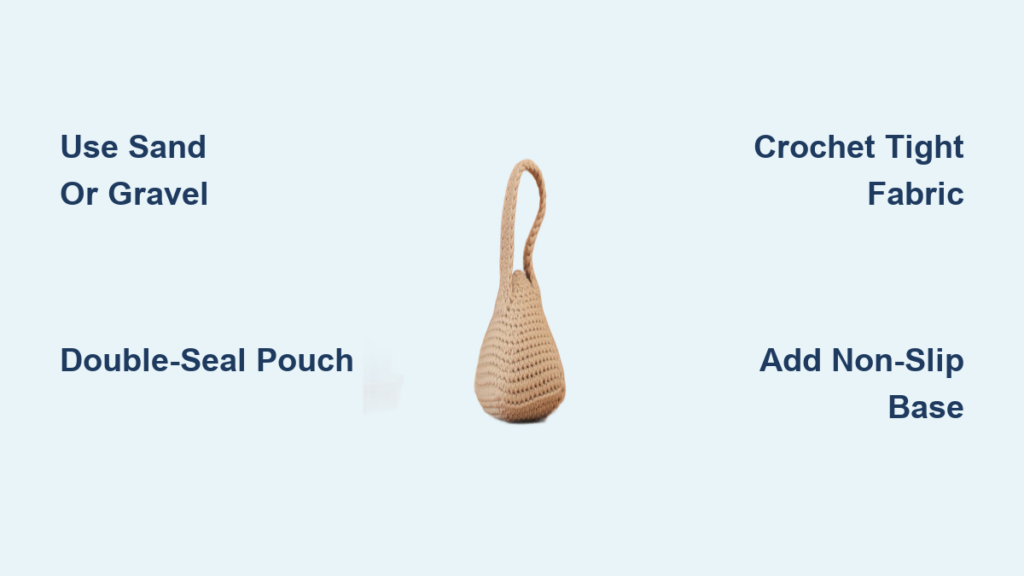
You’ve probably wrestled with a door that refuses to stay open—only to have it slam shut when you need it most. A flimsy store-bought stopper slides across the floor, while a poorly weighted handmade version topples over uselessly. The secret to a truly effective crocheted doorstopper isn’t just cute stitches; it’s strategic weighting that transforms your craft into functional home hardware. Learning how to crochet a door stopper that actually holds doors requires precise material choices and construction techniques most tutorials skip. In this guide, you’ll discover exactly how to build a leak-proof weighted core, select fillers that won’t attract pests, and crochet a dense fabric that withstands daily use. By the end, you’ll create a stopper so sturdy it anchors heavy doors without sliding—while looking like a custom decor piece.
Unlike basic amigurumi projects, a working doorstopper demands physics-aware design. The filler must provide serious heft in minimal volume, and the crochet shell must resist abrasion from floor contact. Most crafters fail by using rice or beans (which invite pantry pests) or skipping the critical inner pouch (causing messy leaks). We’ll fix that by focusing on professional-grade methods: a double-sealed weighted core, ultra-tight stitch patterns, and non-slip bases. You’ll avoid common pitfalls like moldy fillers or burst seams while creating a stopper that lasts years. Let’s build your first heavy-duty doorstopper—the right way.
Why Sand and Gravel Beat Rice for Doorstopper Weighting
Your doorstopper’s effectiveness hinges entirely on filler density. Lightweight options like polyester fiberfill create decorative pillows—not functional stops. For real holding power, you need fillers that deliver maximum weight in minimal space. Sand and aquarium gravel excel here, providing 3-5x the density of rice or beans. A 4-inch stopper filled with sand can weigh 1.5 lbs—enough to anchor even heavy interior doors—while rice would require a bulky 8-inch base to achieve similar weight. Crucially, non-food fillers eliminate the pest risks that plague organic options. Weevils and moths feast on rice-filled stops within months, especially in humid climates, turning your craft project into a pantry infestation hazard. By choosing mineral-based fillers, you ensure your crocheted doorstopper remains clean, odor-free, and functional for years.
Sand: The Budget-Friendly Density Champion
Sand delivers exceptional weight at near-zero cost, but requires careful preparation. Bake it at 200°F (93°C) for one hour to eliminate moisture and microbes—cool completely before handling. Use coarse-grain sandbox sand (not fine play sand) to minimize leakage through stitches. For a standard 5-inch stopper, you’ll need 1.5 cups of sand. Always double-bag it: first seal in a small plastic zipper bag, then encase in a tightly stitched cotton liner. This prevents microscopic sand particles from escaping through the crochet fabric over time. Sand-filled stoppers excel in dry climates but avoid them in high-moisture areas like bathrooms, where condensation could compromise the inner seal.
Aquarium Gravel: Maximum Stability Without Leakage
Small, smooth aquarium gravel (2-4mm) provides even greater density than sand with virtually zero leakage risk. Its rounded edges won’t abrade fabric, and the stones’ size prevents migration through tight crochet stitches. For a doorstopper that must withstand daily dragging across hardwood floors, gravel is ideal—it won’t shift or settle like sand, ensuring consistent weight distribution. Use 1 cup of gravel for a 5-inch stopper. Pro tip: rinse stones thoroughly before use and dry in sunlight for 24 hours to eliminate residual dust. Unlike sand, gravel requires no baking, but always test a single stone against your crochet fabric—sharp edges can snag stitches during insertion.
Fillers That Destroy Doorstoppers: Critical Avoidance List
Why Rice and Beans Guarantee Pest Infestations
Rice, lentils, and dried beans seem like logical fillers—they’re heavy and readily available. But they’re biological time bombs. In 72 hours of humidity, these organic materials attract grain weevils and Indian meal moths that lay eggs inside the stopper. Within weeks, you’ll see tiny holes in your crochet fabric as larvae escape. Worse, moisture exposure causes sprouting or mold—turning your cute doorstopper into a slimy, foul-smelling hazard. Crafters in humid zones report rice-filled stops developing black mold within two months. Save these for pantry storage only; never use them in functional doorstops.
Cat Litter and Birdseed: Hidden Expansion Dangers
Clumping cat litter is a catastrophic choice—it expands 300% when exposed to moisture (like a spilled drink), bursting seams and creating a clay landslide under your door. Even non-clumping litter poses risks: silica dust can migrate through stitches, and clay particles attract moisture that degrades fabric. Birdseed shares rice’s pest vulnerability while adding bird mite risks. Buckwheat hulls seem eco-friendly but attract carpet beetles that chew through crochet fabric. If you prioritize safety and longevity, skip all organic fillers entirely—your crocheted doorstopper should never smell like a compost bin.
Building a Leak-Proof Inner Pouch: The Two-Layer System
Step 1: Double-Sealing Your Weighted Core
The inner pouch is your doorstopper’s backbone—get this wrong, and sand spills everywhere. Cut heavyweight cotton or canvas into two 6×6 inch squares. Place filler inside one square, then sandwich with the second. Machine-stitch ¼ inch from the edge using a zigzag stitch, leaving a 2-inch gap. Insert a small plastic zipper bag filled with your sand or gravel through this gap. Seal the plastic bag completely, then hand-stitch the fabric gap shut with a whipstitch using heavy-duty thread. This double barrier ensures zero leakage even if the outer fabric wears. For gravel, skip the plastic bag—sew French seams (fold edges inward twice before stitching) for ultimate strength.
Step 2: Testing Pouch Integrity Before Crocheting
Never assume your pouch is secure. Fill it with water (for sand/gravel projects) or dry rice (for pellet projects) and shake vigorously over newspaper for 60 seconds. If moisture or particles escape, reseal immediately. Also test weight distribution: place the pouch on a flat surface—it should sit squarely without tilting. Adjust filler volume if needed. A properly sealed pouch should withstand 5 lbs of pressure without leakage. Only after passing this test should you proceed to crocheting the outer shell.
Crocheting a Tight, Non-Slip Fabric Shell

Yarn and Hook Selection for Maximum Density
Standard plush yarn creates porous fabric that shows filler lumps and leaks sand. For a functional doorstopper, use 100% cotton (like Lily Sugar’n Cream) or a cotton/acrylic blend with tight ply. Crucially, choose a hook 2 sizes smaller than your yarn’s recommendation—a 3.5mm hook for worsted-weight yarn creates near-felted density. Work in continuous spirals (no joining rounds) to avoid weak seams. For extra tightness, use the waistcoat stitch (insert hook under both top loops, yarn over, pull through both loops)—this creates a ribbed, non-stretch fabric that resists abrasion. Each stitch should feel firm, with no gaps visible when held to light.
Pyramid Base Construction for Floor Stability
A flat base prevents tipping—start with a 12-chain foundation. Join to form a ring, then work 12 single crochets (sc) into the ring. Increase by 12 stitches per round for Rounds 2-4 (24 sc, 36 sc, 48 sc). In Round 5, stop increasing—work 48 sc even. For the critical base stability, work Rounds 6-7 in back loops only (BLO). This creates a reinforced ridge that anchors the stopper to floors. After Round 7, decrease by 12 stitches over Rounds 8-9 (36 sc, 24 sc). Fasten off, leaving a 6-inch tail for sewing. The resulting pyramid shape distributes weight evenly—no more wobbling when doors swing shut.
Securing the Weighted Core and Final Assembly
Insertion Technique to Prevent Fabric Stress
Place your sealed inner pouch inside the crochet shell before closing the top. Gently push filler into corners using a blunt chopstick—avoid sharp tools that could puncture the pouch. The shell should feel snug but not overstretched; if fabric gaps appear, your pouch is too large. For smooth insertion, chill the pouch in the freezer for 15 minutes—it temporarily reduces volume. Once positioned, check that weight centers low in the base (critical for stability). If the stopper tilts forward, redistribute filler toward the back.
Invisible Closure with Ladder Stitch
Fold the shell’s top edge inward ½ inch and pin. Thread a yarn needle with matching yarn. Insert needle under the front loop of one stitch, then under the back loop of the opposite side—pull gently to close. Repeat, alternating sides, for a seamless closure that won’t gape under weight. Weave ends through 8 stitches inward, then trim. Never use slip stitches—they create weak points where filler can push through. For pet-friendly stops, add a drop of fabric glue inside the seam before stitching to prevent curious claws from unraveling it.
Adding Non-Slip Protection for Hardwood and Tile
DIY Felt Base Attachment in 3 Steps
Cut a 3-inch circle from non-slip shelf liner (the kind with rubberized bumps). Position it on the stopper’s base, aligning with the BLO ridge. Thread a needle with doubled cotton thread, knot the end. Pierce through the crochet fabric and liner near the edge, then take a tiny backstitch through both layers. Repeat every ½ inch around the perimeter—do not sew through the inner pouch. Tie off with a quilter’s knot hidden under the liner. This creates a grippy surface that prevents sliding on slick floors while hiding any minor fabric imperfections.
Maintenance Secrets for Long-Lasting Doorstoppers
Spot-Cleaning Without Damaging the Core
Never submerge your crocheted doorstopper—water will seep into the inner pouch. For scuffs, mix 1 tsp dish soap with ¼ cup cool water. Dip a microfiber cloth, wring until nearly dry, and dab stains gently. Immediately blot with a dry cloth. For stubborn marks, use a soft toothbrush with baking soda paste (1 tsp baking soda + 2 drops water), working in circular motions. Always air-dry upright for 24 hours before reuse. If odors develop, place the stopper in a sealed bag with activated charcoal for 48 hours—never use vinegar or bleach.
Monthly Safety Checks to Prevent Disasters
Inspect seams weekly for loose threads, especially where the base meets the body. Run fingers along stress points—if you feel grit, your inner pouch is leaking. Test stability monthly: place stopper against a closing door. If it slides more than 1 inch, your filler has settled—reposition it through the top seam. Replace inner pouches every 18 months as fabric weakens. For homes with pets, reinforce top seams with clear nail polish to deter chewing. A well-maintained crocheted doorstopper should last 5+ years—far outperforming flimsy plastic alternatives.
By mastering strategic weighting and tight construction, your crocheted doorstopper becomes indispensable home hardware—not just a craft project. Remember: mineral fillers only, double-sealed pouches, and BLO base reinforcement are non-negotiable for functionality. Start with a small gravel-filled stopper for interior doors, then scale up to sand for exterior doors. Within two hours, you’ll have a custom piece that combines handmade charm with serious holding power. When guests ask where you bought it, smile and say, “I crocheted it”—then watch their amazement as it effortlessly anchors even the heaviest oak door.