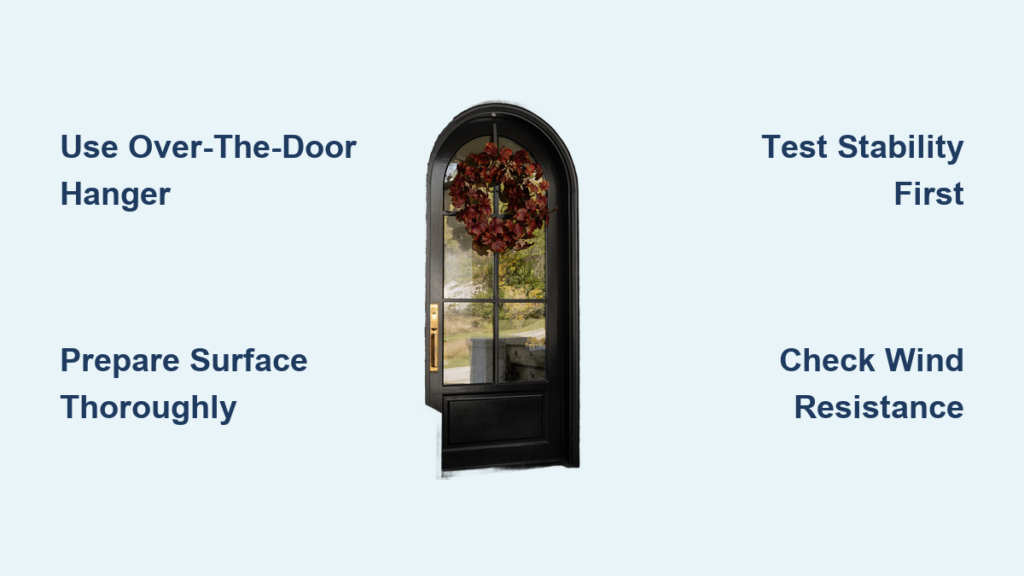
You’ve selected the perfect holiday wreath, but your elegant curved or paneled front door presents a frustrating challenge. Traditional hanging methods fail on these stylish doors because they lack the flat surface needed for standard hooks and adhesives. This comprehensive guide solves your problem with proven techniques that secure your wreath beautifully while protecting your door’s finish. Whether you have a gently arched Craftsman door or a deeply paneled Victorian entry, you’ll discover exactly how to hang a wreath on a curved door safely and effectively—no damage, no stress, and perfect positioning every time.
Most homeowners make the mistake of trying standard adhesive hooks or nails on curved surfaces, only to find their wreath sliding off or worse—damaging the door’s finish. The frustration of constantly readjusting a crooked wreath or discovering paint chips after removal is completely avoidable when you use the right approach. In this guide, you’ll learn professional methods that work with your door’s unique shape rather than fighting against it, saving you time, money, and the headache of door repairs.
Why Standard Hanging Methods Fail on Curved Doors
The Physics of Wreath Hanging on Non-Flat Surfaces
Curved and paneled doors create specific challenges that flat surfaces don’t present. When you attempt to use a standard adhesive hook on a convex curve, only a tiny portion of the adhesive makes contact with the door surface. This dramatically reduces holding power—sometimes by as much as 80% compared to flat application. For paneled doors with recessed sections, hooks either sit unevenly across multiple planes or rest precariously on the narrow raised edges, creating an unstable base that can’t support even lightweight wreaths.
Damage Risks of Improper Hanging Techniques
Many homeowners resort to desperate measures when standard hooks fail, causing permanent damage to expensive entry doors. Using nails or screws on curved surfaces often results in cracked wood fibers as the fastener forces the material to flatten unnaturally. Adhesive hooks removed from curved surfaces frequently take paint or finish with them because the peeling action creates uneven stress across the hook’s base. Even seemingly harmless ribbon tied around knobs can create pressure points that dent softer wood finishes over time.
Weight Distribution Problems Specific to Curved Doors
The curvature of your door creates a natural leverage point that works against wreath stability. As your wreath hangs, gravity pulls it downward, but on a curved surface, this creates a rotational force that pushes the top of the wreath away from the door. This is why wreaths on curved doors often appear to “slide” downward or tilt at an awkward angle—the hanging mechanism simply can’t counteract the physics of the curved surface. Understanding this principle is crucial for selecting the right hanging solution.
Best Over-the-Door Hangers for Curved Surfaces

Selecting the Perfect Hanger Design for Your Door Profile
Not all over-the-door hangers work equally well on curved doors. The critical feature to look for is a wide, flat hook that distributes weight evenly across the top edge of your door. For doors with significant curvature (more than 1/4 inch of variation across the top), choose hangers with adjustable arms that can conform to your specific door shape. The best models feature a U-shaped design that cradles the top edge rather than just hooking over it, preventing the common problem of hangers sliding to one side when the door opens.
How to Test Hanger Stability Before Hanging Your Wreath
Before committing your valuable wreath to any hanger, perform this simple stability test: Position the empty hanger on your door and open/close the door five times. A quality hanger will remain perfectly centered without shifting more than 1/8 inch. Then, hang a weight similar to your wreath (a filled water bottle works well) and gently shake the door. If the hanger moves more than slightly or makes creaking sounds, it’s not suitable for your door’s curvature. This test prevents the disappointment of discovering instability after you’ve hung your decorative wreath.
Top-Rated Hangers for Different Curved Door Types
For gently curved doors (common on Craftsman and Shaker styles), the “Wreath Keeper Pro” model provides exceptional stability with its 360-degree rotating hook and non-marring silicone grips. Deeply curved or arched doors (like many Victorian or Tudor styles) work best with the “ArchHanger Deluxe” which features adjustable arms that accommodate curves up to 3/4 inch deep. Paneled doors with multiple recessed sections require the “PanelPro Hanger” with its segmented base that conforms to complex door profiles. Each of these specialized hangers costs between $12-$22 but pays for itself by preventing door damage that could cost hundreds to repair.
Adhesive Solutions That Actually Work on Curved Doors
When Adhesive Hooks Can Succeed (And When They’ll Fail)
High-quality adhesive hooks can work on curved doors—but only under specific conditions. They’re viable for smooth, non-porous surfaces like fiberglass or metal doors with gentle curvature (less than 1/8 inch variation). For wooden doors, only use adhesive hooks on factory-finished, smooth surfaces—not on textured or hand-finished doors. The critical factor is surface contact: press your finger against the door where you plan to place the hook. If you can feel any curvature through your fingertip, adhesive hooks will likely fail. In these cases, over-the-door hangers remain your safest option.
Step-by-Step Surface Preparation for Maximum Adhesion
Proper surface preparation doubles adhesive hook effectiveness on marginal curved surfaces. Start by cleaning the area with isopropyl alcohol on a microfiber cloth, using circular motions for 30 seconds. For stubborn residues, make a paste of baking soda and water, gently rub it on the surface, then wipe clean. Allow the area to dry completely—this takes 10-15 minutes in normal conditions but up to an hour in humid climates. Before applying the hook, warm both the adhesive pad and the door surface with a hairdryer on low for 20 seconds; this increases molecular bonding. Press the hook firmly in place for 60 seconds, applying even pressure across the entire base.
The 72-Hour Cure Rule You Must Follow
Most homeowners make the critical mistake of hanging their wreath too soon after applying adhesive hooks. For curved surfaces, the adhesive needs full curing time to develop maximum strength. Wait the full 72 hours before hanging anything—this is non-negotiable for curved surfaces where adhesion is already compromised. During this period, avoid opening the door more than necessary, as movement stresses the developing bond. If you absolutely must hang your wreath sooner, reduce the waiting time to 24 hours only if you’ve properly prepared the surface and used a high-strength adhesive designed for curved applications.
Perfect Wreath Positioning on Curved Doors
Finding the Ideal Hanging Height for Visual Balance
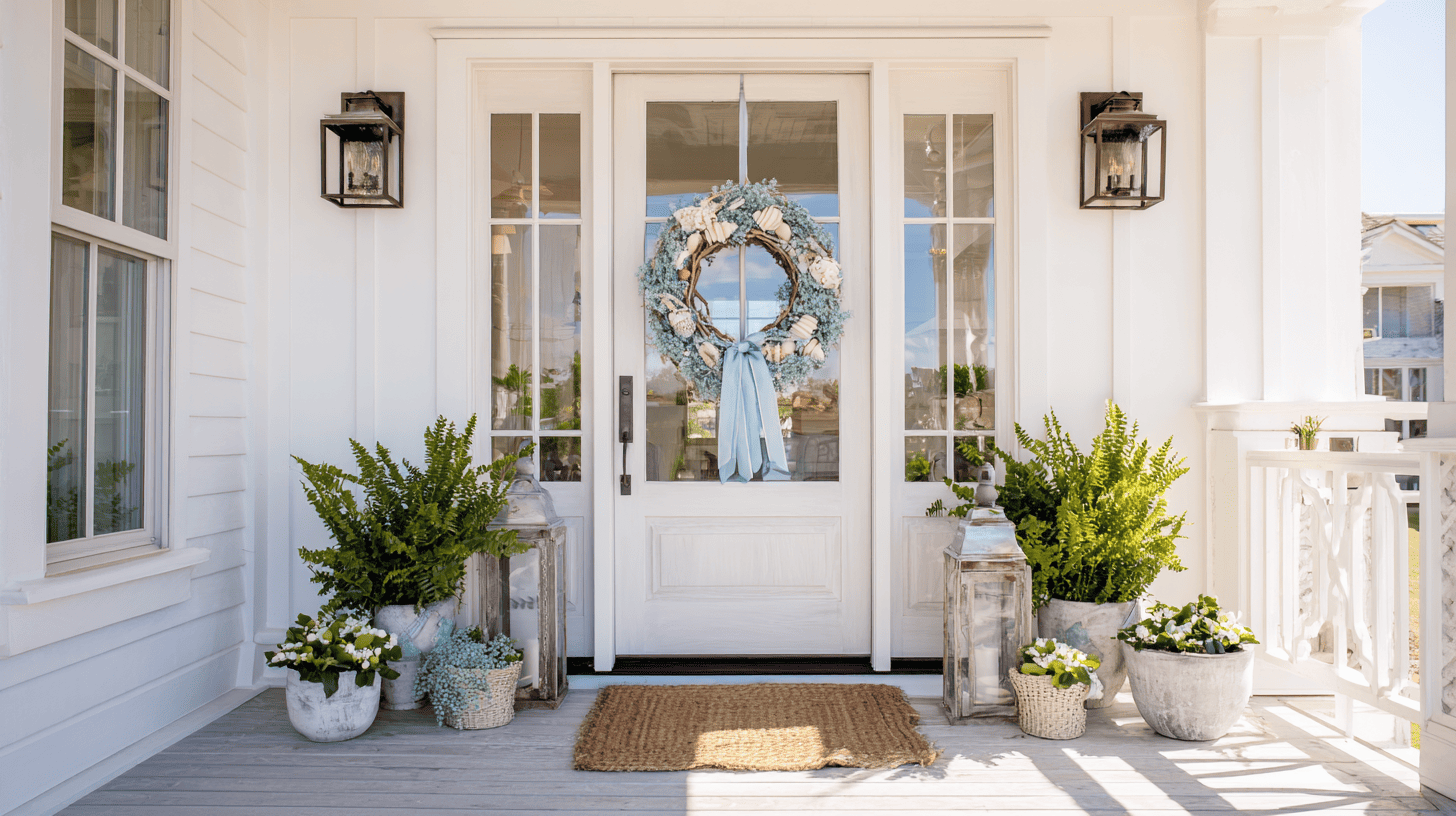
On curved doors, the standard “one-third down from the top” rule needs adjustment. Stand back 6-8 feet from your closed door and visualize a vertical line through the center. The top of your wreath should intersect this line at approximately 42-48 inches from the floor—slightly lower than on flat doors to counteract the visual effect of the curve. For double doors, position the wreath on the inactive door (the one that doesn’t open frequently) to prevent constant disturbance. If your door has prominent panels, align the bottom of the wreath with the top of the main panel section for the most harmonious appearance.
Securing Wreaths Against Wind and Weather
Curved doors create wind tunnels that can dislodge even securely hung wreaths. Prevent this by adding a discreet secondary support: Thread a clear fishing line through the bottom of your wreath frame and attach it to a small, hidden hook on your door kickplate or threshold. The line should be taut enough to prevent swinging but invisible from a normal viewing distance. For extra security in windy areas, place two small dabs of museum putty (the kind used for hanging posters) at 3 and 9 o’clock positions on the back of your wreath where it contacts the door. This creates subtle points of adhesion without damaging the door.
The Tug Test: Verifying Security Before Finalizing Placement
Never skip this crucial verification step: With your wreath in position, grasp it firmly and pull downward with about 5 pounds of force (similar to what wind might exert). A properly secured wreath should not move more than 1/4 inch. Next, push the wreath gently toward the door—there should be no rattling or movement against the door surface. Finally, open and close your door five times while observing the wreath’s stability. If it shifts more than slightly during any of these tests, readjust your hanging method before considering the job complete.
Maintaining Your Curved Door’s Finish During Seasonal Changes

Seasonal Adjustment Techniques for Year-Round Display
Curved doors expand and contract with temperature changes more noticeably than flat doors, requiring seasonal wreath adjustments. In summer heat, wood doors can expand up to 1/8 inch, potentially causing over-the-door hangers to bind. Check your hanger monthly during extreme temperatures and adjust its position if you hear creaking when opening the door. For adhesive hooks, apply a thin layer of silicone-based furniture polish around the edge of the hook base before extreme temperature changes—this creates a barrier that prevents the adhesive from bonding too strongly to expanding wood fibers.
Safe Removal Methods That Preserve Your Door’s Finish
When it’s time to take down your wreath, follow these steps to protect your curved door: For over-the-door hangers, lift straight up while supporting the weight of the hanger—never pull outward, which can scratch the door edge. With adhesive hooks, use dental floss or fishing line to slice through the adhesive bond: Thread the line behind the hook base and saw gently side-to-side while applying slight downward pressure. If any residue remains, apply a small amount of peanut butter (the oil breaks down adhesive) and let it sit for 15 minutes before wiping clean with a microfiber cloth.
Preventing Common Seasonal Damage Patterns
Curved doors show damage patterns that flat doors don’t—particularly at the transition points between curved and flat sections. Protect these vulnerable areas by applying clear vinyl edge guards (available at hardware stores) along the most pronounced curves before hanging your first seasonal wreath. These nearly invisible strips absorb the friction that would otherwise wear through your door’s finish over multiple hanging seasons. For paneled doors, place small felt pads at the corners of recessed panels where wreath wires might rub against the raised edges during windy conditions.
By implementing these specialized techniques, you’ll enjoy beautiful, secure wreath displays on your curved door season after season—without compromising your door’s integrity or finish. The right hanging method transforms what many consider a decorating challenge into an opportunity to showcase your style with confidence. Remember that the small investment in proper hanging tools pays dividends in preserved door value and stress-free seasonal decorating. With your wreath perfectly positioned and securely fastened, you’ll create that welcoming entrance you’ve always wanted, regardless of your door’s unique shape.