You’re standing outside your own home, patting empty pockets as panic sets in. That familiar jingle of keys is missing, and your door handle won’t budge without them. Being locked out wastes precious time and racks up stress—especially when you’re late for work or stranded in bad weather. How to open door handle without key situations happen to 1 in 3 homeowners annually, but most resort to costly emergency locksmith calls unnecessarily. This guide reveals proven non-destructive techniques that work on standard interior and exterior doors, plus critical red flags signaling when professional help is essential. You’ll learn exactly which household items can save you $100+ in service fees while avoiding the common mistakes that damage locks.
Why Your Door Handle Refuses to Budge Without the Key
Most exterior doors combine two locking mechanisms that behave differently when keys are missing. The spring latch (the curved metal piece you see when the door is open) retracts when you turn the handle, but a deadbolt extends a solid metal rod deep into the frame. Spring latches can often be bypassed using non-destructive methods, while deadbolts require professional intervention. If your handle won’t turn at all, you likely have a deadbolt engaged—don’t force it. For spring latches, the gap between door and frame is your entry point. Look for a 1/8-inch space where the latch meets the strike plate; if visible, non-destructive methods stand a chance.
How Spring Latches Differ From Deadbolts Visually
Stand close to your locked door and examine the latch area. A spring latch shows a slanted, curved metal piece that’s spring-loaded—it compresses when the door closes. A deadbolt appears as a separate, thicker metal rod (usually 1-2 inches in diameter) that slides horizontally. If you see two separate metal pieces extending into the frame, you have both mechanisms. Critical tip: The credit card method only works on spring latches. Attempting it on deadbolts bends tools and damages door edges.
Credit Card Method: Step-by-Step for Spring Latches
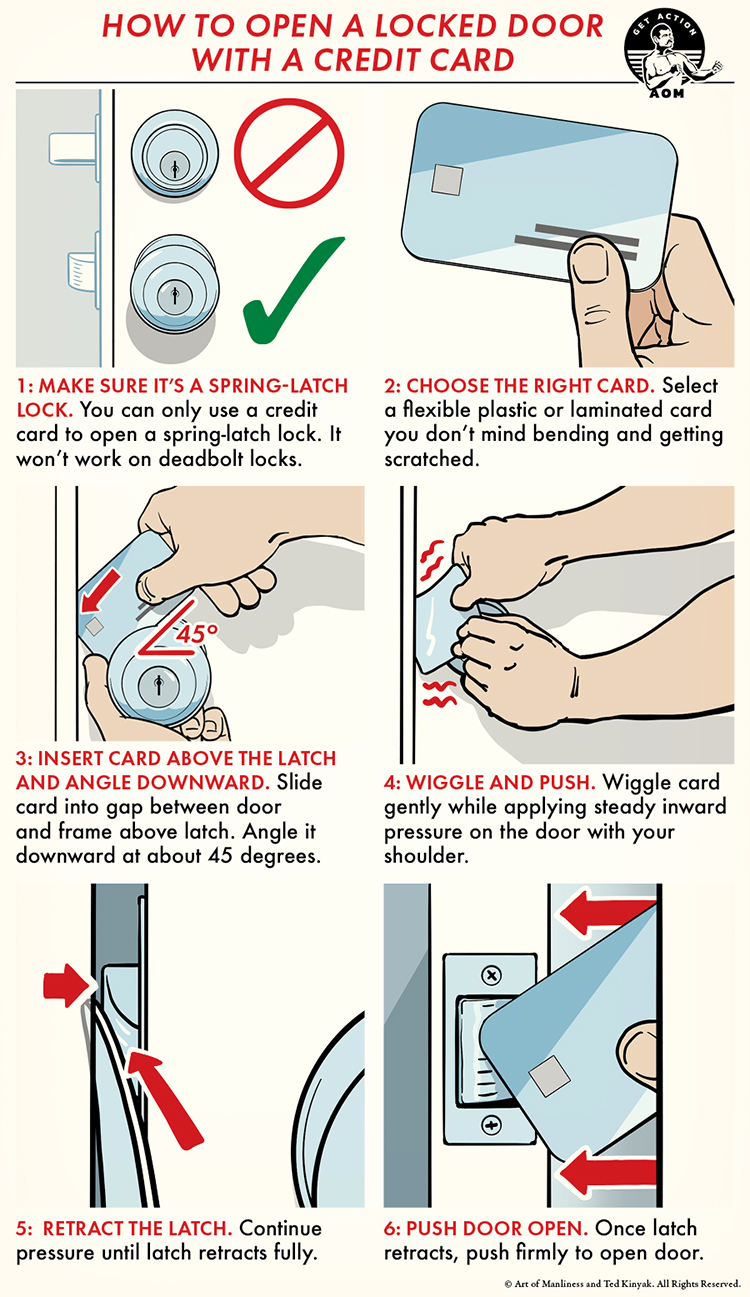
This technique exploits how spring latches automatically retract when pressure is applied to their angled face. It works within 60 seconds on inward-swinging exterior doors and most interior doors—but fails completely on deadbolts or outward-swinging doors. Success depends entirely on your door’s swing direction and latch type.
Why Your Credit Card Method Failed Last Time
Most people insert the card flat against the door frame instead of angling it downward toward the latch mechanism. If you’re pushing straight in without angling, you’re scraping the frame, not contacting the latch. Another fatal error: using stiff cards like driver’s licenses that snap instead of flexing. Pro tip: Hold the card vertically (long edge horizontal) and insert it at a 45-degree downward angle. You should feel resistance within 1 inch of insertion—that’s the latch.
Perfecting the Wiggle Technique
- Insert: Slide your flexible card (hotel key card or expired gift card works best) into the gap at latch height
- Angle: Tilt the card’s top toward you at 30 degrees to direct force downward
- Wiggle: Rapidly jiggle the card up/down while applying inward pressure on the door
- Turn: Simultaneously rotate the handle as if opening the door normally
- Repeat: If it sticks, pull the card out 1/2 inch and reinsert—debris often blocks the latch path
This method takes 2-5 minutes of practice. If the door doesn’t budge after 10 attempts, stop—you likely have a security-enhanced deadlatch.
Alternative Tools When You Lack a Credit Card

No plastic card? Household items can create the same latch-retracting leverage. Butter knives and metal spatulas work best for thicker gaps, while guitar picks excel in tight spaces. Avoid screwdrivers—they scratch paint and jam mechanisms.
Best Household Items for Non-Destructive Entry
- Thin metal ruler: Slide under the latch at 20-degree angle, then twist upward
- Bobby pin: Unfold into a straight wire, insert through keyhole to push latch (for knob locks)
- Old guitar pick: Insert vertically, use the curved edge to “scoop” the latch back
- Putty knife: For gaps over 1/4 inch, angle toward latch and apply steady pressure
Critical warning: Never use credit cards on outward-swinging doors—they’ll snap instantly. For these, skip to hinge removal methods.
When to Abandon DIY Methods Immediately
Certain situations mean non-destructive techniques will fail, and continued attempts cause costly damage. Stop immediately if you hear grinding noises—this means you’re forcing metal parts beyond their tolerance. Another red flag: if the handle turns freely but the door won’t open, the latch is broken internally and requires disassembly.
Deadlatch Detection: The Paper Test
Slide a business card vertically between door and frame at latch height. If it slides through easily, you have a standard spring latch. If it stops abruptly 1/2 inch in, you have a security deadlatch (designed to block credit card methods). This is your critical decision point: Attempting bypass on deadlatches bends strike plates and requires $150+ repairs.
Emergency Hinge Removal for Outward-Swinging Doors
Outward-swinging exterior doors (common on commercial buildings and some homes) bypass credit card limitations. By removing hinge pins, you literally lift the door off its frame—no lock manipulation needed. This works in 5 minutes but requires specific tools.
Step-by-Step Hinge Pin Removal
- Stabilize: Place wedges under the door bottom to prevent shifting
- Expose pins: Tap the hinge pin upward using a nail set and hammer
- Lift: Once the top pin is out, support the door’s weight while removing lower pins
- Reinstall: Reverse the process after entry—align pins carefully to avoid misalignment
Time estimate: 4-7 minutes with proper tools. Never attempt this during rain or high wind—doors can swing violently.
When to Call a Professional Locksmith Immediately
Call a locksmith before sunrise if you see these signs:
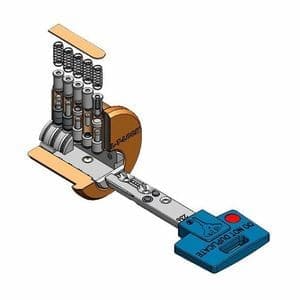
– Your lock has a keyhole shaped like a diamond (high-security Medeco or Mul-T-Lock)
– The door has multiple bolts extending from all four corners
– You smell smoke or hear distress inside (never delay for emergencies)
Reputable locksmiths open 95% of residential locks in under 10 minutes without damage. Insist on upfront pricing—beware of “low fee” ads that charge $200+ after arrival. Verify licenses through your state’s contractor board website before letting anyone near your door.
Preventing Future Lockouts: The 10-Second Spare Key Fix
The average lockout costs $95 in service fees—easily avoided with one strategic spare key. Never hide keys under mats or rocks—thieves check these first. Instead, use a ShurLoc Key Vault ($25) bolted to a porch beam. For true keyless freedom, install a Schlage Encode smart lock ($149) that unlocks via fingerprint or app. Test your system monthly: Stand outside after dark and verify you can enter within 30 seconds.
Critical Legal Boundaries You Must Respect
Attempting these methods on any property you don’t own is felony trespassing in all 50 states. Even practicing lock picking on a friend’s door requires written consent—many jurisdictions treat unprompted lock manipulation as burglary preparation. Document forced entries with timestamped photos for insurance claims, but never share bypass techniques publicly. When in doubt, call 911 for medical emergencies instead of risking injury.
Stop wasting money on preventable lockouts. Master the credit card method for spring latches, recognize deadbolt dead-ends, and implement the ShurLoc vault solution today. For immediate relief, keep a locksmith’s number saved in your phone—not just in your contacts, but as a home screen widget labeled “EMERGENCY ENTRY.” Within 24 hours, duplicate your keys and hide one properly. Your future self will thank you when keys vanish at 2 AM. Remember: Non-destructive entry is a homeowner’s right when done legally, but forced entry destroys security. When techniques fail, a $75 locksmith call beats $300 in damaged door repairs every time.