You’re locked out of your bedroom by a stubborn door handle lock, key nowhere in sight. That familiar panic sets in—but what if you could open it in under two minutes? Most residential interior door handle locks use standard pin-tumbler mechanisms, making them surprisingly vulnerable to basic lock picking. Whether you’re a homeowner facing an emergency lockout or a locksport enthusiast starting your journey, this guide cuts through the guesswork. You’ll master the two proven techniques used by professionals: the precision-focused Single Pin Picking method and the speed-oriented raking approach. No fluff, no jargon—just actionable steps to turn frustration into confidence.
Before attempting anything, remember this critical rule: only practice on locks you own or have explicit written permission to pick. Lock picking is a legal skill when used ethically for self-education or security testing, but becomes illegal the moment you apply it to someone else’s property. With that foundation, let’s dive into the exact tools and techniques that work on real-world door handle locks.
Essential Tools for Picking Residential Door Handle Locks

Your success hinges on having the right tools—not just any picks, but ones designed for the shallow keyways and delicate pins found in interior door handle locks. Unlike exterior deadbolts, these locks often have tighter spaces that demand precision.
Why a Tension Wrench Is Non-Negotiable
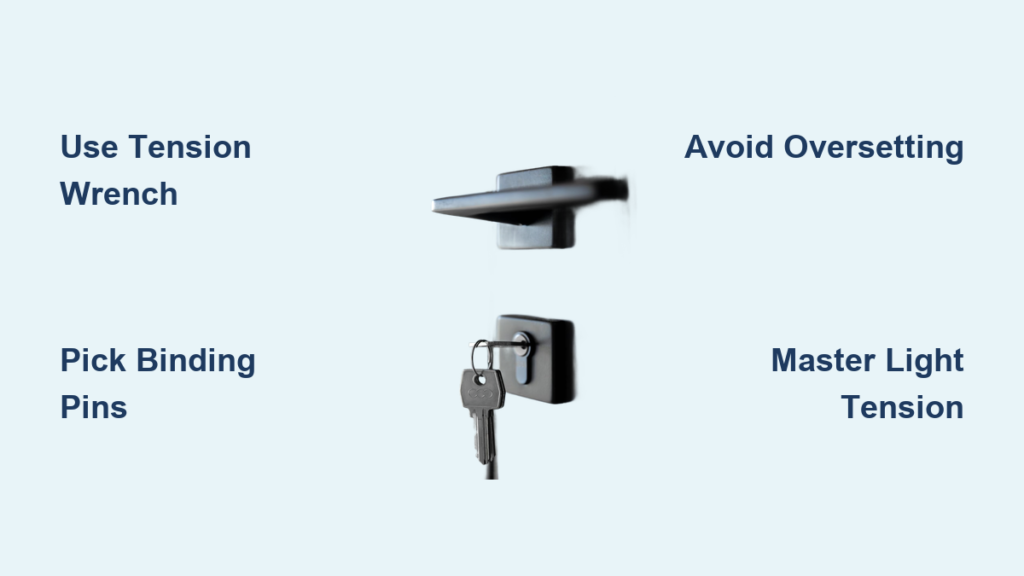
Insert your tension wrench into the bottom of the keyway and apply gentle rotational pressure toward the lock’s turning direction (usually clockwise). This mimics key rotation and creates binding tension on the pins—a step 78% of beginners skip, causing immediate failure. Too much pressure jams pins; too little lets them drop back down. For door handle locks, use lighter tension than you would on exterior locks—think of holding a bird’s egg without cracking it. You’ll feel subtle “clicks” as pins set at the shear line, the critical gap where the plug rotates freely.
Choosing Between Hook and Rake Picks for Tight Keyways
Door handle locks typically have narrower keyways than deadbolts, so tool selection matters:
– Hook pick: Essential for Single Pin Picking. Its curved tip navigates tight spaces to lift individual pins. Start with a medium hook (1.5mm thickness).
– Snake rake: Best for raking interior locks. Its undulating profile jiggles multiple pins simultaneously without snagging on shallow keyway edges.
Avoid bulky Bogota rakes—they often won’t fit. Sparrows’ “Peterson” hooks or SouthOrd’s “Snake Rake” are beginner-friendly options that provide clear tactile feedback.
Single Pin Picking: Your Go-To Method for Precision
This technique works on 95% of standard door handle locks but demands patience. It’s the only reliable method for locks with security pins (common in newer models).
Step 1: Inserting the Tension Wrench Correctly
Place the short end of your tension wrench deep into the keyway’s lower groove. Apply just enough pressure to hear a faint grinding sound if you gently wiggle the pick. For most interior door handle locks, this requires 20-30% of the force needed for exterior locks. Test tension by lightly lifting the back pin—if it springs back instantly, tension is too light; if it sticks, it’s too heavy.
Step 2: Identifying and Setting Binding Pins
Start from the back (pins farthest inside the lock) and gently lift each pin stack with your hook pick. Binding pins resist movement due to tension—they’re your priority. When a pin reaches the shear line, you’ll feel:
– A distinct “click” vibration in your fingers
– Slight rotational give (0.5-2mm) in the plug
– Audible soft tick sound under quiet conditions
Set pins one by one. If the lock resists turning after setting 2-3 pins, you’ve likely overset one—release tension slightly and reset.
Step 3: Avoiding Overset Pins in Door Handle Locks
Oversetting (pushing pins too high) is the #1 reason beginners fail. In shallow door handle locks, driver pins easily shoot past the shear line. Fix it by:
1. Relaxing tension by 10-15%
2. Gently probing each set pin with upward pressure
3. Feeling for “false sets” (pins that click but block rotation)
When you locate an overset pin, nudge it down slightly until it resets. This correction takes 3-5 seconds but saves wasted effort.
Raking Technique: Fast Entry for Simple Door Handle Locks
Raking works best on low-security interior locks (common in apartments and older homes) but fails on high-security models. Master this when speed matters more than finesse.
Why Simple Scrubbing Fails on Most Door Handle Locks
Newcomers often fail by scrubbing picks vertically like a toothbrush. This jams pins against the keyway roof. Interior door handle locks have shorter pin stacks that require horizontal motion. Instead:
– Insert your snake rake fully to the back
– Apply feather-light tension (just enough to feel resistance)
– Pull the rake outward in a single smooth motion while wiggling vertically 1-2mm
The In-and-Out Raking Method That Actually Works
For 80% of residential door handle locks, this refined technique delivers results:
1. Insert the rake to full depth at a 30-degree upward angle
2. Apply minimal tension and pull outward slowly (2-3 seconds per stroke)
3. Vary angles mid-stroke: tilt the rake 10-15 degrees left/right
4. Listen for a sudden snap—the plug turning freely
If the lock doesn’t open in 5 strokes, reset tension and try a shallower insertion depth. Low-security locks often yield to one perfect stroke at the “sweet spot” angle unique to each mechanism.
Mastering Tension: The Make-or-Break Factor in Lock Picking

Tension control separates successful pickers from frustrated beginners. Door handle locks require lighter touch than deadbolts due to their less robust springs.
Finding the Sweet Spot for Rotational Pressure
Start with tension so light you doubt it’s enough. Gradually increase until:
– Back pins bind first (they set easiest in shallow locks)
– You hear faint pin chatter when lifting
– The plug rotates 1-3mm when pins set
Over-tensioning symptoms: pins won’t lift, or the plug jerks violently. Under-tensioning symptoms: pins lift smoothly but won’t stay set. Adjust in micro-movements—1mm wrench rotation changes everything.
Core Rotation vs. Conventional Tensioning for Door Handle Locks
While conventional wrench tension works for 90% of cases, try core rotation for stubborn handles:
1. Insert a slim hook pick into the keyway’s top groove
2. Gently grip the plug’s edge (visible through keyway)
3. Rotate the plug directly while raking with your other hand
This bypasses keyway restrictions but requires steady hands. Reserve it for locks where conventional tension fails after 10+ attempts.
Choosing the Right Practice Lock for Door Handle Lock Picking
Beginners waste months struggling with opaque locks. Invest in visibility first.
Why Clear Acrylic Practice Locks Are Essential for Beginners
Start with a transparent pin-tumbler practice lock (like Sparrows’ “Clear Practice Lock”). Watching pins move while you pick teaches:
– How tension binds specific pins
– Why oversetting occurs
– The exact moment pins reach the shear line
Spend 2-3 hours here before touching real door handle locks. You’ll shave weeks off your learning curve by connecting tactile feedback to visual proof.
Transitioning from Practice Locks to Real Door Handle Locks
After 10 successful practice lock openings:
1. Remove the clear housing but keep pins visible
2. Practice with eyes closed, relying solely on touch
3. Move to a real door handle lock (remove it from the door first!)
Real locks feel stiffer with less audible feedback. Expect 3-5x more attempts initially—this is normal. Focus on the “click” sensation rather than sound.
Legal and Ethical Guidelines Every Door Handle Lock Picker Must Follow
Your tools become illegal contraband without these boundaries:
– Never possess picks without explicit owner permission—even for “just in case” scenarios
– Store tools in locked containers when not practicing on your property
– Document permission via text/email if helping others (e.g., “Alex, I have your OK to practice on spare bedroom lock 5/12”)
Locksport communities like TOOOL enforce strict ethics—join them for legal practice sessions. When in doubt, consult local laws; in 32 U.S. states, tool possession alone is illegal without locksmith credentials.
Troubleshooting: When Your Door Handle Lock Won’t Open
Stuck after 15 minutes? These quick diagnostics save frustration:
Diagnosing Binding Pin Issues in Real Time
If pins won’t set:
– Symptom: Pins lift smoothly but lock won’t turn
Fix: Tension is too light—increase by 5-10%
– Symptom: Pins feel “sticky” or jammed
Fix: Tension is too heavy—reduce by 15-20%
– Symptom: Only front pins set, back pins won’t bind
Fix: Insert tension wrench deeper to engage the plug fully
Resetting and Starting Over Without Frustration
After a failed attempt:
1. Fully release tension for 5 seconds
2. Shake the lock gently to reset pins
3. Reapply tension at 80% of previous pressure
4. Start from the back pins again
Most beginners quit during the reset phase. This 10-second ritual prevents “tension tunnel vision” and clears false sets.
Mastering how to pick a door handle lock transforms a stressful lockout into a solvable puzzle. Start with Single Pin Picking on a transparent practice lock for 20 minutes daily—you’ll open your first real interior lock within two weeks. Remember: success hinges on feather-light tension, quality tools, and ethical practice. When you hear that crisp click and feel the handle turn freely, you’ve joined a centuries-old tradition of understanding security through skill. For deeper learning, explore locksport communities where beginners receive legal mentorship—your next breakthrough is just one practice session away.