Picking the wrong window tint can lead to failed inspections, sweltering cabins, and wasted money on films that bubble or fade within months. With dozens of percentages, materials, and legal restrictions to navigate, most drivers end up guessing instead of choosing with confidence. The trick is understanding how Visible Light Transmittance (VLT), film technology, and local regulations work together to match your specific vehicle and lifestyle.
This guide breaks down everything you need to make a smart tint decision. You’ll learn how to read VLT percentages correctly, compare dyed, carbon, ceramic, and crystalline films, and avoid costly mistakes like illegal darkness or signal-blocking metallic layers. Whether you drive a sedan in Arizona or an EV in Minnesota, you’ll walk away knowing exactly which tint fits your needs.
Start with Legal Limits Before Anything Else
Every state and province sets its own rules for window tint, and ignoring them can mean fines, forced removal, or failed safety inspections. Always confirm your local laws before falling in love with a specific shade.
Front Side Window Rules
Front side windows face the strictest regulations in most regions. Common legal minimums range from 35% to 70% VLT, depending on where you live. For instance, California and New York require at least 70% VLT on front side windows, while Texas allows 25%.
If your vehicle already has factory-tinted glass, adding film may push the combined VLT below legal limits. Always calculate the total light transmittance before installing.
Rear Window Flexibility
Rear side and back windows usually allow much darker films. Many states permit 15% to 20% VLT, and some allow limo tint (5%) as long as the vehicle has dual side mirrors. This is where you can prioritize privacy without breaking the law.
Windshield Restrictions
Windshields are heavily restricted across North America. Most jurisdictions only allow a non-reflective strip of 5 to 6 inches along the top edge. A handful of states permit full-windshield tint if it exceeds 70% VLT and doesn’t obstruct the driver’s view.
Pro Tip: Work with a certified installer who stocks state-compliant films and applies legal certification stickers. They keep you off the ticket radar.
Match Tint Darkness to Your Driving Style

VLT percentage determines how dark the film looks and how much light enters your cabin. Choose based on visibility needs, privacy goals, and climate.
70% VLT and Higher: Nearly Invisible Protection
This ultra-light range looks almost like clear glass but still blocks UV rays and reduces glare. It’s ideal for windshields or drivers in strict states who want protection without altering their vehicle’s appearance. Pair it with crystalline or high-transmission ceramic film for the best results.
50% to 70% VLT: Light Shade, Smart Compromise
A 50% to 70% tint adds a slight shade that improves comfort without hurting night vision. It’s a popular choice for front side windows where visibility matters most. This range also pairs beautifully with factory rear privacy glass for a clean, OEM-style finish.
35% to 50% VLT: The Balanced Sweet Spot
This range offers noticeable privacy and heat reduction while staying safe for night driving. 35% VLT is legal in many states and pairs perfectly with 20% on the rear windows for a stylish two-tone look. It’s the go-to choice for drivers who want comfort and compliance.
20% to 35% VLT: Darker Rear Windows
Darker films in this range match factory privacy glass on most SUVs and trucks. They provide real privacy for passengers and cargo while blocking significant heat and glare. Use 20% on the rear and 35% on the front for a uniform, legal appearance.
5% to 15% VLT: Maximum Privacy, Front Windows Forbidden
Limo tint offers total obscurity but is illegal on front windows in nearly every state. It creates dangerous blind spots at night and should only be applied to rear windows on work vans, delivery vehicles, or SUVs where maximum privacy outweighs visibility concerns.
Visual Tip: Dark interiors make tint appear darker from outside. Light-colored cabins may require a slightly darker film to achieve the same look.
Choose the Right Film Material for Your Budget and Climate

Film material determines heat rejection, durability, and electronic compatibility. Here’s how the main options stack up.
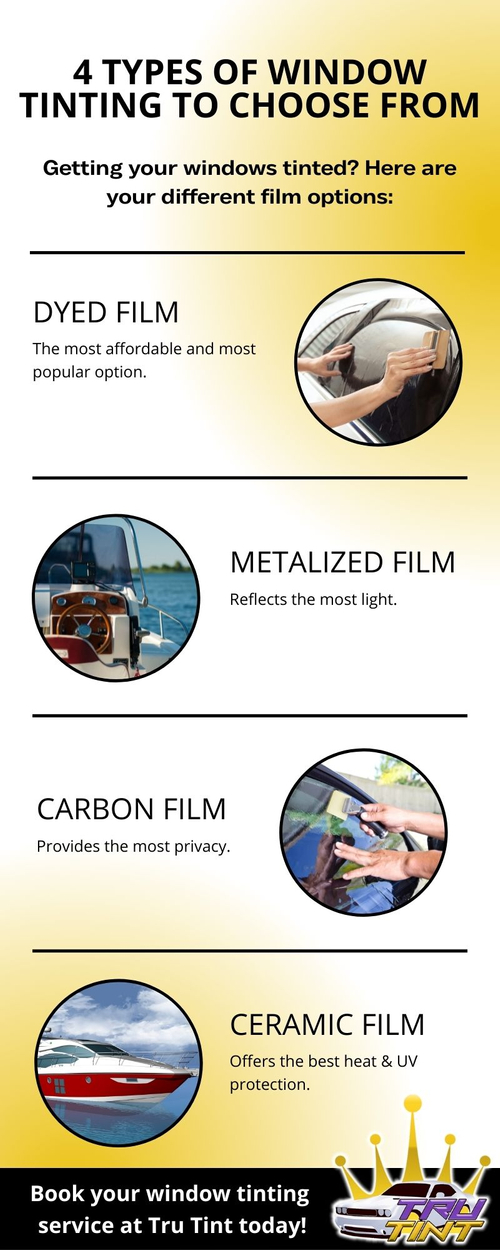
Dyed Tint: Cheap but Short-Lived
Dyed film costs between $100 and $200 and reduces glare effectively. However, it absorbs heat instead of reflecting it, fades quickly in hot climates, and may turn purple within a few years. Best for short-term use or tight budgets.
Carbon Tint: Durable and Stylish
Carbon film uses nano-carbon particles to block up to 99% of UV rays while resisting fade. It has a sleek matte finish, doesn’t interfere with electronics, and typically costs $200 to $400. It’s an excellent mid-tier choice for daily drivers and classic cars.
Ceramic Tint: Premium Heat Rejection
Ceramic film blocks 90% to 96% of infrared heat and 99% of UV radiation without any metallic interference. It reflects sunlight rather than absorbing it, keeping cabins up to 60°F cooler and reducing AC load. Expect to pay $400 to $800 or more, but the performance and longevity justify the investment for hot climates and electric vehicles.
Metalized Tint: Strong but Signal-Hostile
Metalized film reflects heat effectively and adds shatter resistance, but its metallic particles can block GPS, Bluetooth, and cell signals. It works well for older vehicles with minimal electronics but isn’t recommended for modern cars with keyless entry or navigation systems.
Hybrid Tint: The Middle Ground
Hybrid films combine dyed and metalized layers for better heat rejection than basic dyed film, with reduced signal interference. Priced between $150 and $350, they suit budget-conscious buyers who want better performance than entry-level options.
Crystalline Tint: Invisible Defense
Crystalline film blocks over 90% of IR and 99% of UV while remaining nearly transparent. It’s perfect for windshields or legally restricted windows where clarity is non-negotiable. The premium price ($500 to $900) reflects its advanced multi-layer optical technology.
Optimize for Climate and Daily Habits

Your environment and routine should shape your final decision more than aesthetics alone.
Hot Climates Demand IR Rejection
If you live in Arizona, Florida, Texas, or Southern California, prioritize infrared rejection over darkness. Ceramic or high-end carbon films are essential. Dyed film will absorb heat and make your cabin hotter, increasing AC use and fuel consumption.
Cold Climates Need UV Defense
In northern states or Canada, UV rays cause dashboard cracking and skin damage even in winter. Choose carbon or ceramic film with 99% UV blocking and a lighter VLT (50% to 70%) to maximize winter light and warmth.
Night Drivers Should Stay Lighter Up Front
If you drive frequently at night or in rain, avoid tints below 35% VLT on front windows. Dark films reduce depth perception and reaction time. A safer combination is 50% VLT on the front paired with 20% on the rear.
EV Owners Should Invest in Ceramic
For Tesla, Rivian, or Lucid drivers, cabin heat directly drains battery range. Ceramic tint reduces AC workload and can preserve 5% to 10% more range in summer. It also won’t interfere with keyless entry, Autopilot, or cellular connectivity.
Handle Factory Privacy Glass the Right Way
Many SUVs and sedans ship with factory privacy glass on rear windows, usually around 15% to 20% VLT. But here’s the catch: factory tint blocks almost no heat or UV. It’s purely cosmetic.
To match factory rear glass with aftermarket film on the front, apply the same VLT percentage. For a darker uniform look, apply a lighter film (like 45%) over factory glass to achieve an effective 15%. To add protection without darkening, apply 70% crystalline film over existing glass for invisible UV and IR defense.
Always Choose Professional Installation
Even premium film fails with poor installation. Certified installers use heat guns, precision cutters, and squeegees to ensure a bubble-free fit on curved glass. Most professional films include lifetime warranties against bubbling, peeling, and fading.
DIY installation risks dust contamination, creases, edge peeling, and voided warranties. A $400 ceramic tint professionally installed lasts 10+ years, while a $100 DIY job may need removal and reapplication within three years, costing more in the long run.
Maintain Your Tint for Maximum Lifespan
Proper care keeps your tint performing and looking new for years.
During the First 3 to 5 Days
Don’t roll down your windows. Avoid touching or cleaning the film. Keep windows closed to prevent air pressure from lifting the edges before the adhesive fully cures.
Cleaning Best Practices
Use ammonia-free cleaners like a vinegar-water mix or specialized tint spray. Wipe with soft microfiber cloths or rubber squeegees. Avoid Windex, paper towels, and abrasive pads that scratch or damage the adhesive.
Winter De-Icing Tips
Never scrape ice directly off tinted film. Use a de-icer spray or lukewarm water, and scrape gently from the edges inward to avoid catching the film’s perimeter.
Use the Decision Matrix to Finalize Your Choice
Still torn between options? Match your priority to the right film.
| If You Want | Choose This Film | Recommended VLT |
|---|---|---|
| Maximum heat reduction | Ceramic | 35% front, 20% rear |
| Best overall value | Carbon | 35% to 50% |
| Legal clarity with full protection | Crystalline | 70%+ |
| Budget privacy | Dyed | 20% to 35% |
| Zero signal interference | Ceramic or Carbon | Any |
| Shatter resistance | Metalized or Ceramic | Any |
Frequently Asked Questions About Window Tint
What VLT percentage is legal for front side windows?
Front side window laws vary by state, but most require at least 35% to 70% VLT. California and New York mandate 70%, while Texas allows 25%. Always check your specific state regulations before installing.
Does window tint block cell phone and GPS signals?
Only metalized films interfere with signals. Ceramic, carbon, and dyed films are non-metallic and won’t disrupt Bluetooth, GPS, Wi-Fi, or cell reception.
How long does window tint typically last?
Quality ceramic and carbon films last 10+ years with proper care. Dyed films may fade or bubble within 3 to 5 years, especially in hot climates.
Can I apply tint over factory privacy glass?
Yes, but the combined VLT will be darker than either layer alone. A 45% film over 20% factory glass produces an effective 15% VLT from outside.
Is ceramic tint worth the higher cost?
Ceramic tint costs more upfront but blocks up to 96% of infrared heat, reduces AC use, and lasts over a decade. For hot climates and EV owners, the energy savings and comfort justify the investment.
How long before I can roll down windows after tinting?
Wait 3 to 5 days to let the adhesive fully cure. Rolling windows down too early can cause the film to shift, peel, or bubble at the edges.
Final Thoughts on Choosing the Right Window Tint
Selecting window tint isn’t about chasing the darkest shade or the lowest price. It’s about aligning performance, legality, and lifestyle into one smart decision. Start by confirming your local VLT laws, then prioritize heat rejection, UV defense, or clarity based on your climate and driving habits. Invest in ceramic or carbon film from a certified installer for the best long-term value, and follow proper maintenance to protect your investment.
Your next step is simple: measure your front and rear windows, check your state’s VLT requirements, and book a consultation with a reputable tint shop. Ask for samples of carbon and ceramic film at your target VLT, and compare them side by side in direct sunlight. The right tint will keep your cabin cooler, your interior protected, and your drives more comfortable for years to come.