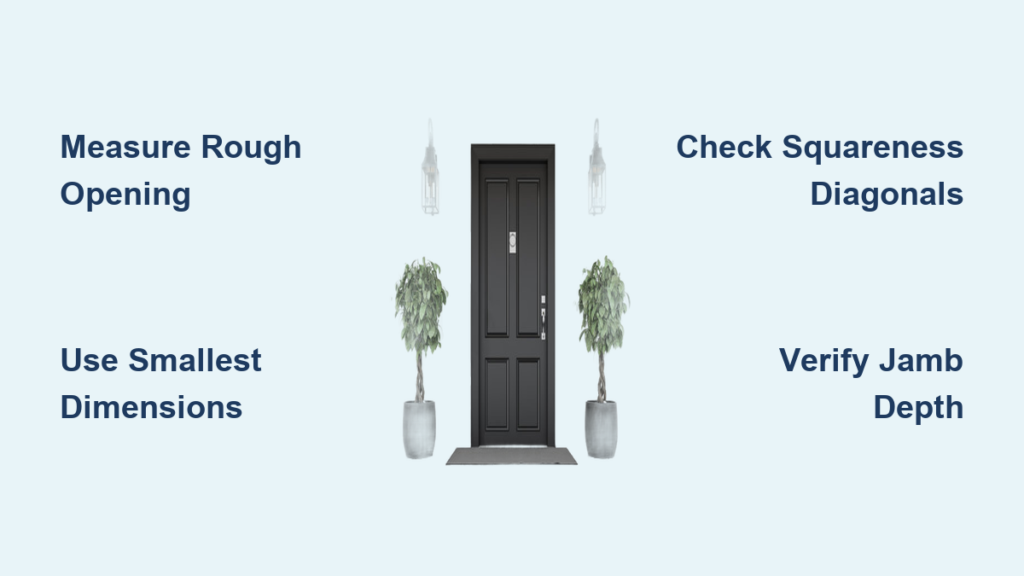
Measuring an exterior door correctly is the foundation of a successful replacement or installation. Whether you’re upgrading for energy efficiency, curb appeal, or security, inaccurate measurements can lead to costly mistakes like a door that won’t close, drafts coming through gaps, or a unit that simply doesn’t fit. The key is knowing whether you’re measuring for a prehung door (frame included) or just a door slab (panel only), then following precise steps to capture width, height, thickness, and opening conditions. This guide walks you through every measurement with professional-level accuracy, using tools available to both DIYers and contractors. You’ll learn how to avoid common pitfalls, verify squareness, and ensure your new door fits perfectly, even in older, non-standard homes.
Measure for Prehung Door: Rough Opening

When replacing an entire door unit including the frame and hinges, you must measure the rough opening, which is the structural space between studs, above the sill, and beneath the header.
Remove Interior Trim Safely
Start by exposing the full jamb and framing to get accurate dimensions. Score along the trim with a utility knife to prevent paint chipping, then slide a putty knife behind the molding to protect the wall before gently prying it off with a pry bar. Set aside reusable trim and remove old foam, insulation, or debris behind it. This reveals the actual framing and ensures your measurements aren’t skewed by surface materials.
Capture Width at Three Points
Take three horizontal measurements across the rough opening: just below the header, at mid-height, and just above the sill. Measure from the inner edge of one jamb stud to the inner edge of the other. Record all values and use the smallest number, which accounts for any out-of-square framing and guarantees your prehung door will fit. For example, if you get 37-1/2″, 37-3/4″, and 37-1/4″, your effective width is 37-1/4″.
Record Height on All Sides
Measure vertically in three places: the left side, center, and right side. Go from the underside of the header to the top of the sill. Pull back carpet, tile, or baseboard at the threshold to hit the true sill surface. Again, take the shortest measurement to ensure clearance, because if one side is lower due to settling, that’s your limiting dimension.
Determine Jamb Depth (Wall Thickness)
Measure from the outer face of exterior sheathing to the inner face of interior drywall. This tells you what jamb depth to order: 4.5″ for standard 2×4 walls or 6.5″ for 2×6 construction. Prehung doors come with jambs built for these depths, and matching yours ensures proper alignment and weather sealing. If your wall is non-standard, you may need custom trim or adjustable jambs.
Measure for Door Slab Only
If the existing frame is intact and square, you can replace just the door panel, saving time and money compared to a full prehung unit replacement.
Identify Swing Direction First
Check whether the door is inswing (hinges inside, opens inward) or outswing (hinges outside, opens out). This determines hinge mortise placement and latch orientation on the new slab. Stand outside: if hinges are on the left, it’s a left-hand swing; on the right, it’s right-hand.
Measure Frame Opening Width
Take three horizontal measurements inside the jamb at the top, middle, and bottom. Measure from the inner face of one door stop to the other, being careful not to include the stops themselves. Use the smallest value and round up to the nearest inch. A 31-7/8″ width becomes a 32″ door.
Check Frame Height Accurately
Measure vertically from the top of the head jamb to the top of the sill in three places: left, center, and right. Use the shortest reading. Remember that flooring changes like new tile adding 3/4″ can affect this, so always measure to the final intended floor level.
Confirm Door Thickness
Remove the slab and measure its edge. Exterior doors are almost always 1.75″ (1¾”) thick, which is notably thicker than interior doors at 1⅜”. Don’t assume, because steel and fiberglass doors often cannot be trimmed, making an exact thickness match critical.
Verify Squareness and Alignment

Even small misalignments cause doors to bind, leak air, or fail to latch properly, so checking these details before ordering saves significant headaches later.
Test Diagonal Measurements
Measure corner to corner in an X pattern: top-left to bottom-right and top-right to bottom-left. If both diagonals are equal, the frame is square. A difference greater than ¼ inch means the opening is out of square, which means you should replace with a prehung unit instead of just a slab.
Use a Level on Jambs
Place a 24″ level on the head jamb (top) to check for level (horizontal), then test both side jambs for plumb (vertical). If out of alignment, the frame has shifted, which is common in older homes. Shimming during installation can correct minor issues, but severe misalignment requires full replacement.
Understand Rough vs. Nominal Size
Don’t confuse the door size with the rough opening needed, because manufacturers build in specific clearance gaps for installation adjustments.
Standard Size Conversion
Add clearance for shims and adjustment: 2 inches to width and 2.5 inches to height. A 36″x80″ door requires approximately a 38″x82.5″ rough opening. Always confirm with manufacturer specs, because some require up to 39.9375″ wide for a 36″ door.
Real-World Example
A homeowner measured a rough opening of 39-3/8″ wide x 81-1/8″ tall. While wide enough for a 36″ door, the height was 1.375″ too short. The solution was to modify the header or order a custom door, neither ideal, but height is often the limiting factor in door replacements.
Adjust Opening to Fit Standard Doors
Custom doors cost 2 to 3 times more than standard sizes, so minor framing tweaks are usually the more economical choice.
Increase Height Safely
Cut ¾” or more from the bottom of the jack stud or header, using a temporary support post to hold the structure during modification. Even 1″ of added height can save hundreds on a custom order.
Narrow an Oversized Opening
Add wood blocking or shims inside the jamb to reduce width, or re-frame one side with new studs if the gap is large. Adjustable jambs can also compensate for slight variances.
Replace Damaged Sills
Rot or uneven thresholds cause fit issues, so install an adjustable aluminum or vinyl sill that accommodates height differences while maintaining water runoff slope.
Record and Order with Confidence
Avoid returns, delays, and misfits by documenting everything meticulously before contacting suppliers.
Use Minimum Values Only
Always go with the smallest measured dimension for width and height, because this guarantees the door fits even if the opening is slightly uneven.
Double-Check Before Buying
Re-measure after recording your initial numbers. Photograph the opening with dimensions written on paper and placed inside. Label images clearly and bring all data to the supplier to confirm material type, trim allowance, and actual shipped slab size.
Measure Special Door Types
Double Exterior Doors
Measure the total width of both panels, or individually if replacing just one. Confirm height (usually 80″), thickness (1¾”), and whether there’s a center mullion (fixed post) or true pair configuration.
Doors with Sidelights
Treat each component separately, measuring the active door width, height, and thickness, then each sidelight individually by width and height inside the jambs. Measure total assembly width and confirm jamb depth matches your wall thickness.
Handle Older Home Challenges
Homes built before 1950 often have non-standard openings due to settling, repairs, or hand-framing techniques that differ from modern construction.
Key Tips for Older Homes
Never assume standard sizes apply in older houses. Measure everything manually and be ready to modify framing. Always prioritize standard doors to save money, because custom doors carry significant premium costs.
Avoid Common Measurement Mistakes
Best Practices
Measure three times per dimension and use the smallest value recorded. Clear paint, caulk, and debris before measuring, and pull back flooring to measure true height. Keep removed trim for reinstallation and round up the final size when ordering.
Mistakes to Avoid
Don’t measure only once or include door stops and trim in slab width measurements. Don’t forget new flooring height or assume all 80″ doors fit standard openings. Never trust automated deductions without verification, because some retailers apply deductions to the frame rather than the door slab itself.
Final Measurement Checklist
Before ordering, confirm that interior trim has been removed and saved, the rough opening is cleared of debris, three width measurements have been taken with the smallest used, and three height measurements have been taken with the shortest used. Verify door thickness is confirmed as 1.75″, swing direction is identified, level and plumb are verified, and diagonals have been checked with a difference of ¼” or less. Take photos with dimensions labeled, consult the supplier with final numbers, confirm material trim allowance, and pull back floor coverings for true height measurement.
Frequently Asked Questions About Measuring Exterior Doors
What measurements do I need for a prehung exterior door?
For a prehung door, you need the rough opening width (measured from inner jamb stud to inner jamb stud in three places, using the smallest), rough opening height (measured from underside of header to top of sill in three places, using the shortest), and jamb depth (measured from exterior sheathing to interior drywall).
How do I measure for a door slab replacement?
Measure the frame opening width from inner face to inner face of door stops (not including the stops), measure height from head jamb to sill, and confirm door thickness at 1.75″. Take three measurements each and use the smallest values.
Should I use the largest or smallest measurement when ordering?
Always use the smallest measurement recorded. This accounts for out-of-square framing and ensures your door will fit, with shim space allowing you to fill any gaps during installation.
How much clearance does a prehung door need?
Add 2 inches to the door width and 2.5 inches to the door height for rough opening requirements. For example, a 36″x80″ door needs approximately a 38″x82.5″ rough opening.
Can I install a standard door in an older home?
Older homes often have non-standard openings, so you may need to modify the framing to fit a standard door. Measure carefully and be prepared to adjust header height or jack stud positioning.
What happens if my measurements are wrong?
Incorrect measurements lead to doors that won’t close properly, gaps that let in drafts, or units that don’t fit at all. Custom orders typically cannot be returned, and many suppliers won’t honor warranties if you provided the measurements.
Key Takeaways for Measuring Your Exterior Door
Accurate door measurements prevent costly mistakes and ensure proper fit, weather sealing, and security. Always measure the rough opening (for prehung units) or frame opening (for slab replacements) in three locations per dimension, using the smallest values to guarantee clearance. Understand the difference between nominal door sizes and required rough openings, and account for flooring changes that affect height. Verify squareness with diagonal measurements and check level and plumb before ordering. When in doubt, have a professional measure your door, especially for expensive custom units.