You’ve found the perfect replacement door online, but when it arrives, it doesn’t fit. Why? The most common culprit: inaccurate measurements. Whether you’re replacing an interior bedroom door or installing a new exterior entryway, knowing how to measure door size correctly is essential for a smooth installation. A small error of just 1/4 inch can mean gaps, misaligned hardware, or a door that won’t close properly.
This guide covers everything you need to know to measure any door with confidence. You’ll learn how to measure height, width, and thickness for both slab replacements and full prehung systems. You’ll also discover how to determine door swing, avoid common mistakes, and understand industry standards so your new door fits perfectly the first time.
Measure Door Slab Dimensions Correctly
Use these steps when replacing only the door panel (slab) and reusing the existing jamb or frame.
Measure Height at Three Points
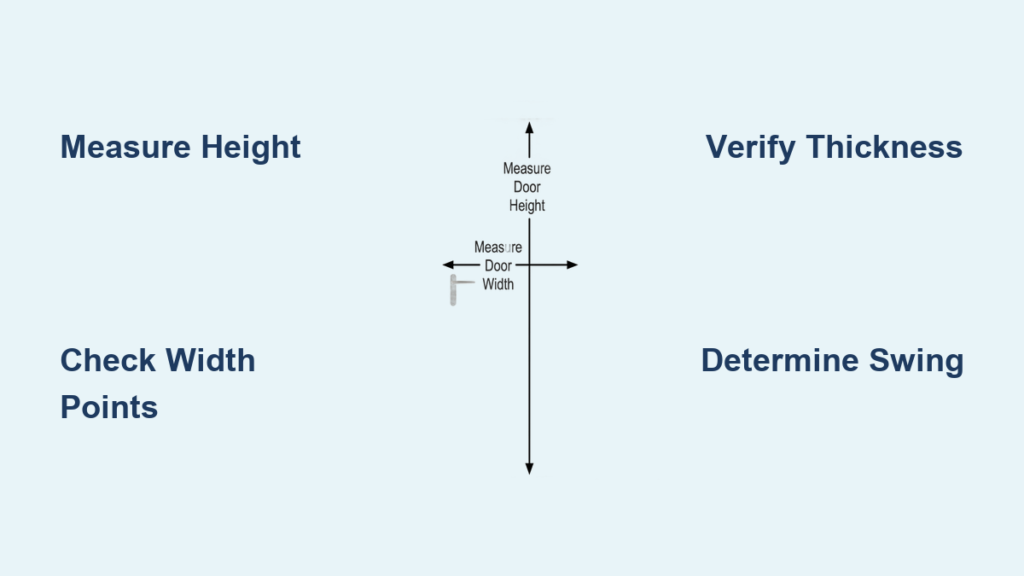
Stand inside the room with the door closed. Measure from the bottom edge to the top edge in three places: near the left side, the center, and the right side. Exclude any door sweep, threshold, or weatherstripping from your measurement. Record the tallest of the three measurements as your official height.
Standard door heights are 80 inches, 84 inches, or 96 inches. If your measurement falls between sizes, round up to the next standard size. For example, a measured height of 79¼ inches rounds up to 80 inches.
Measure Width at Multiple Points
Measure horizontally across the top, middle, and bottom of the door. Take measurements on both faces (inside and outside) if possible. Use the widest of all readings as your official width.
Common door widths are 24 inches, 28 inches, 30 inches, 32 inches, or 36 inches. For non-integer values, always round up to the next full inch. A width of 29¾ inches should be rounded to 30 inches.
Measure Thickness Edge to Edge
With the door open, measure straight through the side edge from the interior face to the exterior face. Interior doors typically measure 1⅜ inches (1.375 inches), while exterior doors usually measure 1¾ inches (1.75 inches). Older or custom doors may vary, so always verify this dimension.
Use calipers or a ruler pressed flat against the edge for accuracy. This measurement is critical for proper hardware alignment and seal integrity.
Measure Rough Opening for Prehung Doors

When installing a prehung door system that includes the jamb, frame, and slab together, you must measure the rough opening in the wall, not the door itself.
Measure Rough Opening Height
For interior doors, measure from the finished floor to the top of the header or horizontal jamb. For exterior doors, measure from the threshold surface to the top of the jamb. Avoid measuring over flooring that overlaps the sill, as this skews results.
Take three vertical measurements at the left, center, and right sides. Record the largest value. Standard practice allows 2 inches additional height. An 80-inch door needs an 82-inch rough opening.
Measure Rough Opening Width
Measure from the outer edge of one stud to the outer edge of the opposite stud. This is your rough opening width. The rough opening is typically 2 inches wider than the door slab. A 36-inch door requires a 38-inch rough opening.
Never measure inside the jamb unless confirming fit for a flush-mount setup.
Verify Jamb Depth Matches Wall Thickness
Jamb depth equals the total wall thickness including framing and drywall. Standard jamb depth is 4 9/16 inches (4.5625 inches) for 2×4 walls with ½-inch drywall on both sides. Measure from the back of interior casing to the back of exterior casing.
For 2×6 walls, expect depths around 6 9/16 inches, which requires special deep jambs. Mismatched depth causes uneven trim or gaps, so verify before ordering.
Determine Door Swing and Handedness
Getting the swing wrong means hinges and handles end up on the wrong side. Here’s how to determine door swing correctly.
Identify Left or Right Hand
Stand facing the door jamb with the door open. Position your back against the hinge side. Extend the arm on the same side as the hinges. If your right arm extends, you have a right-hand swing. If your left arm extends, you have a left-hand swing.
Distinguish Inswing from Outswing
Inswing doors open into the room, which is most common for interior doors and many exterior doors. Outswing doors open outward and are common on exterior doors for weather protection.
There are four combinations: left-hand inswing, right-hand inswing, left-hand outswing, and right-hand outswing. For exterior doors, outswings prevent water intrusion, so confirm direction before ordering.
Use the Handshake Test
Imagine shaking hands with someone entering through the door. If the door handle is on your right, it’s a right-hand swing. If it’s on your left, it’s a left-hand swing. This simple mental exercise prevents confusion when ordering.
Handle Special Door Types

Some doors require extra attention due to their design or age.
Measure Double Doors Properly
Measure each door individually for width, height, and thickness. Also measure the total opening width including the mullion (center post). Confirm which door is active (has latch) and which is passive (fixed or bolted).
Total rough opening should be 2 inches wider than combined slab widths. Two 30-inch slabs equal 60 inches total, requiring approximately a 62-inch rough opening.
Install Flush-Mount Doors Correctly
For flush-mount doors with no traditional jamb, measure inside edge to inside edge of the opening. This equals the slab size. A 36-inch flush door shows exactly 36 inches between jamb interiors.
Confirm rough opening is 2 inches wider and 2 inches taller than the slab. Verify jamb depth matches wall construction. Precision is critical for these modern or minimalist designs.
Handle Older or Non-Standard Doors
Homes built before 1970 may have odd sizes such as 78 inches tall or 30¾ inches wide. Always measure precisely rather than assuming standard dimensions. Round up to the nearest standard size when possible.
If no standard size fits, consider custom fabrication. Pre-1950 homes often used lath-and-plaster walls where jamb depth may differ from modern standards.
Follow Measurement Best Practices
Avoid errors with these proven techniques.
Use the Right Tools
Use a steel tape measure with a locking mechanism. Keep a notepad or phone handy to record measurements instantly. Use a level to check for plumb and square. Take photos of the door in the frame for reference.
Avoid cloth tape measures because they stretch and give false readings.
Take Multiple Readings
Warped doors or out-of-square frames create variation. Always measure top, middle, and bottom for width. Measure left, center, and right for height. Use the largest number in each category to ensure the door will fit.
Always Round Up
Round any fraction up to the next whole inch for width. Round to the nearest standard height (80, 84, or 96 inches). A slightly oversized door can be trimmed, but a small one cannot be fixed.
Industry rule states that exactness isn’t required, but always round upward.
Label and Double-Check
Write down each measurement clearly, such as “Bedroom Door: 32 inches W × 80 inches H × 1⅜ inches T.” Re-measure after recording. Have someone else verify if possible.
Know Industry Standards
Use this quick-reference table when ordering replacement doors.
| Dimension | Interior Door | Exterior Door |
|---|---|---|
| Height | 80″, 84″, 96″ | 80″, 84″, 96″ |
| Width | 24″, 28″, 30″, 32″, 36″ | 30″, 32″, 36″ (36″ typical) |
| Thickness | 1¼”, 1⅜”, 1½” | 1½”, 1¾” |
| Jamb Depth | 4 9/16″ (standard) | 4 9/16″ (standard) |
| Rough Opening | +2″ wider, +2″ taller | +2″ wider, +2″ taller |
A 36 × 80-inch exterior door needs a 38 × 82-inch rough opening and 1¾-inch thickness.
Avoid Common Measurement Mistakes
Even experienced DIYers make these errors. Don’t let them happen to you.
Don’t Measure Only One Spot
Warped doors vary by location. Always take three height and three width measurements to account for this variation.
Don’t Include Thresholds or Sweeps
These components add false height. Measure only the actual door slab.
Don’t Measure Frame Instead of Slab
When replacing just the door panel, measure the slab itself, not the jamb or frame.
Don’t Forget to Round Up
A 29½-inch wide door ordered as 29 inches will leave a noticeable gap. Always round up.
Don’t Misjudge Door Swing
Ordering the wrong hand means returns or costly modifications. Use the handshake test to verify.
Don’t Ignore Jamb Depth
In 2×6 homes, standard 4 9/16-inch jambs won’t fit. Measure wall depth before ordering.
When to Call a Professional
Some situations demand expert help rather than DIY measurement.
Inconsistent Measurements
If readings vary by more than ½ inch, the frame may be damaged or out of square. A professional can assess whether repair or replacement is needed.
Damaged or Rotting Frames
Exterior jambs exposed to moisture may need full replacement. This affects both measurement and installation approach.
Complex Installations
Double doors, sidelights, or arched tops benefit from professional assessment. These require precise alignment that DIYers may struggle to achieve.
Use Manufacturer Support
Many suppliers offer free phone or chat support. Some provide step-by-step video guides or even on-site measurement services for large projects. Send photos of your door with a tape measure in view to help representatives verify swing and size.
Frequently Asked Questions About Measuring Door Size
What measurements do I need to order a replacement door?
You need three core measurements: width, height, and thickness. For a slab-only replacement, measure the door itself. For a prehung system, measure the rough opening. Also determine door swing (left or right hand, inswing or outswing).
Should I round up or down when measuring door size?
Always round up. A door that’s slightly too large can be trimmed during installation, but a door that’s too small cannot be enlarged. Round width measurements to the next whole inch and height measurements to the nearest standard size (80, 84, or 96 inches).
How do I measure a door for a prehung replacement?
Measure the rough opening (stud to stud) rather than the existing door. The rough opening should be 2 inches wider and 2 inches taller than the door slab. Also measure jamb depth to ensure it matches your wall thickness.
What’s the standard door height and width?
Standard height is 80 inches for most interior and exterior doors, with 84 and 96 inches as alternatives. Standard widths are 24 to 36 inches for interior doors and typically 36 inches for exterior doors.
How do I determine if my door is left-hand or right-hand?
Stand facing the door with it open and your back against the hinges. Extend the arm on the same side as the hinges. If your right arm extends, it’s a right-hand door. If your left arm extends, it’s a left-hand door.
Can I replace just the door slab, or do I need the whole frame?
You can replace just the slab if the existing jamb and frame are in good condition. Measure the slab dimensions carefully and match the thickness. If the frame is damaged or warped, replace the entire prehung system.
Key Takeaways for Accurate Door Measurement
Accurate measurement is the foundation of any successful door replacement project. Whether you’re updating a single interior door or installing a new front entry, following these steps ensures a seamless fit, proper function, and professional results without costly returns or delays.
Always measure in multiple locations to account for warping or settling. Use the largest measurement for width and the tallest for height. Round up rather than down to ensure the door isn’t too small. Verify door swing using the handshake method before ordering, as returning a door with the wrong handedness is expensive and time-consuming.
Take photos of your door open and closed, showing hinges and handle position. Record all measurements clearly with labels such as “Master Bath: RH Inswing.” Store these measurements digitally for reference when shopping.
Remember that a well-measured door installs faster, seals better, and lasts longer. When in doubt, order slightly larger rather than smaller, and always double-check every dimension before placing your order.