You’ve decided it’s time to replace a door, whether it’s drafty, damaged, or just outdated. But before you order a new one, there’s one critical step: measuring accurately. A poorly measured door can lead to gaps, binding, misalignment, or a unit that won’t fit at all. The good news? With the right tools and method, learning how to measure a door for replacement is a straightforward DIY task.
The key is knowing what you’re replacing. Are you installing just a door slab, or a full prehung unit? Each requires a different approach. Slab replacements reuse the existing frame and hinges, so you measure the door itself. Prehung doors come with frame, jambs, and hinges, requiring measurement of the rough opening in the wall. Get this wrong, and your new door won’t sit flush or seal properly.
Determine Your Replacement Type First
Slab or Full Unit: What’s Needed
Before pulling out your tape measure, determine what type of replacement you need. This decision changes everything about how you measure.
A door slab is just the panel without a frame. Use this when your existing jamb and hinges are in good condition. It’s ideal for cosmetic upgrades or minor damage. A prehung door is a complete assembly with door, jambs, hinges, and threshold. You’ll need this if your frame is damaged, warped, or out of square. Specialty systems include patio doors, storm doors, or full entry units with sidelites and transoms.
Rule of thumb: Replacing just the door? Measure the slab. Replacing everything? Measure the rough opening behind the trim.
Learn Key Door Terminology Before Measuring
Understanding Door Anatomy
Confusion over terms leads to wrong orders. Learn these components before measuring.
The rough opening is the actual hole in the wall between studs. It’s slightly larger than the prehung unit. The jamb is the vertical frame sides, with standard depths of 4 5/8 inches for 2×4 walls and 6 5/8 inches for 2×6 walls. The head is the top horizontal part of the frame. The threshold is the bottom seal on exterior doors.
The slab is the door panel alone without frame or hinges. Sidelites are vertical glass panels beside the door. Transoms are windows above the door. The casing or trim is the decorative molding around the jamb, which you must remove before measuring for a prehung door.
Critical note: Never measure over trim. It hides the true rough opening and will give you incorrect dimensions.
Gather the Right Tools for Accurate Measurement
Equipment You Need Before Starting
Skip the guesswork with the right tools. Having everything ready ensures you measure correctly the first time.
You’ll need a 25-foot tape measure with dual-scale markings. A level checks plumb and level. A pencil and notepad records every dimension. A straight edge aligns measurements. A flashlight inspects dark corners. A utility knife cuts caulk or paint along trim.
Pro tip: Measure three times, write clearly, and label each value. One mistake can cost time and money.
Measure a Door Slab Correctly
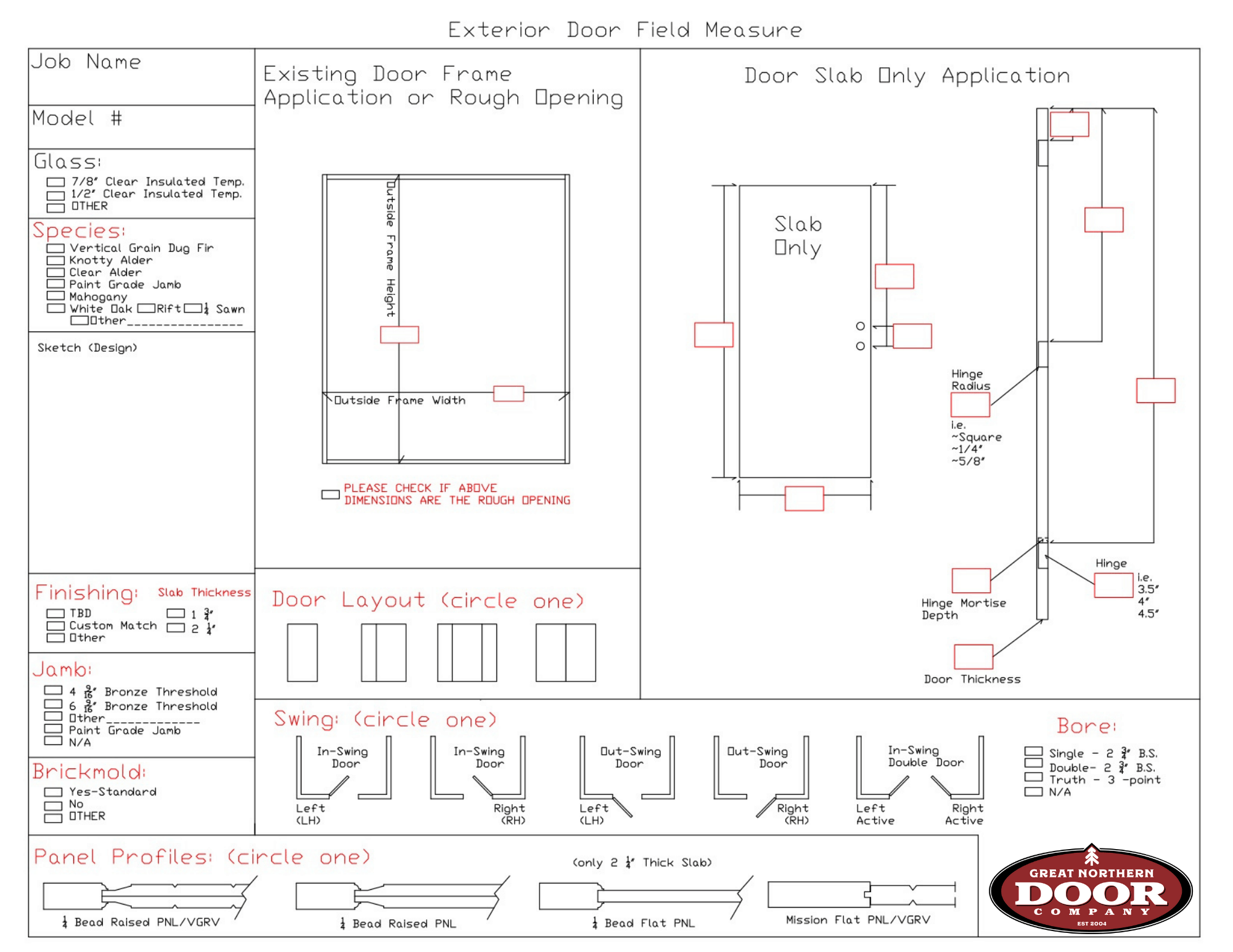
Getting Width, Height, and Thickness Right
When replacing only the panel, measure the existing door slab precisely. This ensures the new panel fits your current frame.
For width, measure edge to edge at three points: top, middle, and bottom. Record all values, then use the smallest measurement to prevent binding in the frame. If ordering stock, round up to the nearest inch. For example, 31.75 inches becomes a 32-inch slab.
For height, measure from bottom to top on both edges and near the center. Use the smallest value to avoid dragging on the floor. Round up to standard height like 80 or 84 inches.
For thickness, measure from front to back of the door. Interior doors are typically 1 3/8 inches thick. Exterior doors are always 1 3/4 inches thick for strength and insulation. Older homes may have non-standard thicknesses, so verify exactly.
Warning: Wrong thickness means hinges and locks won’t align properly.
Recording Hardware Specifications
If reusing hardware, measure additional details. The bore hole diameter is usually 2 1/8 inches. The backset is the distance from door edge to center of the bore hole, typically 2 3/8 or 2 3/4 inches. Measure hinge mortises for depth, width, and height of cutouts. Record hinge locations, measuring distance from top and bottom. Common placements are top hinge 7 inches from top and bottom hinge 11 inches from bottom.
Pro tip: Take photos of the door edge showing hardware for supplier reference.
Measure for a Prehung Door Installation
Accessing the Rough Opening
To get accurate measurements for a prehung door, you must access the rough opening behind the trim.
Carefully pry off the casing or trim from at least one side. This exposes the studs and header, which are critical for accurate measurement. Leave trim intact only if you’re replacing just the slab.
Caution: Use a pry bar gently to avoid damaging drywall.
Measuring Rough Opening Width
Measure left stud to right stud at three points: top, middle, and bottom. Use the smallest width. Add 1/2 inch clearance for shimming.
Example: A 36-inch prehung door needs a minimum 36.5-inch rough opening width.
Measuring Rough Opening Height
Measure from subfloor to header on left, right, and center. Use the smallest height. Add 3/4 inch clearance for shims and flooring.
Example: An 80-inch prehung door requires 80.75 inches of vertical space.
If the floor slopes, base height on the highest point to prevent binding.
Checking Jamb Depth
Measure from interior jamb face to exterior. This matches your wall thickness. Standard depths are 4 5/8 inches for 2×4 walls and 6 5/8 inches for 2×6 walls.
Why it matters: Wrong jamb depth means the door sticks out or sinks into the wall.
Scanning for Obstructions
Inspect for brick mold or exterior trim. Check for siding, stucco, or house wrap. Note flooring types including tile, carpet, and hardwood. Look for electrical outlets or baseboards that might interfere.
Measure how far trim or walls protrude to ensure the new unit clears them.
Critical: Exterior thresholds must sit flush on the finished floor.
Measure Patio Doors Correctly
Individual Panel vs Full Frame
For replacement panels only, measure each sliding panel separately. Measure width at top, middle, and bottom, using the smallest. Measure height on left, right, and center, using the smallest. Thickness is usually 1 3/4 inches, but verify.
Mark which panel slides and on which side.
For full frame replacement, measure the rough opening from stud to stud and subfloor to header. Include track height in your vertical measurement. Switching to French doors may require structural changes, so consult a pro.
Pro tip: Sketch a diagram showing track position and swing direction.
Measure Storm Doors Properly
Width, Height, and Clearance
For width, measure the storm door frame at top, middle, and bottom, using the smallest value. For height, measure from threshold to top on both sides, using the shorter measurement.
Measure how far the main door jamb sticks out from the wall. Match storm door depth exactly. Standard is 4 5/8 inches, but verify.
Ensure no interference with main door swing, exterior lights or house numbers, and screen removal.
Tip: Allow 1/2 inch clearance on all sides for adjustment.
Measure Entry Systems with Sidelites
Sidelite and Transom Dimensions
Measure each sidelite individually. For width, measure inside edge to inside edge of frame. For height, measure from threshold to top, measuring both sides and using the smallest. Typical width is 10 to 18 inches.
Calculate total system width by adding door width plus left sidelite plus right sidelite.
Example: A 36-inch door with 12-inch and 12-inch sidelites equals 60 inches total. This is your order size.
For transom windows, measure width same as door or full frame. Measure height from top of door frame to bottom of transom frame. Confirm if fixed or operable.
Warning: These systems are often custom-ordered, so measure everything precisely.
Reference Standard Door Dimensions
Typical Sizes by Door Type
Never assume standard size. Always measure. But here’s what is typical.
Interior doors come in widths of 24, 28, 30, 32, and 36 inches. Heights are typically 80 inches. Thickness is 1 3/8 inches.
Exterior doors come in widths of 30, 32, and 36 inches. Heights are 80 or 84 inches. Thickness is always 1 3/4 inches.
Patio doors range from 60 to 84 inches total width at 80 inches tall. Entry systems with sidelites range from 48 to 72 inches or more in width.
Reminder: Older homes often have non-standard sizes. Measure anyway.
Apply Rounding Rules Correctly
Ordering Specifications
For slab width, round up to the next inch. For slab height, round up to standard. For thickness, specify exactly.
Use this order notation: Width x Height x Thickness. Example: 32 x 80 x 1 3/8 for an interior slab.
For prehung units, include jamb depth. Example: 36 x 80 x 1 3/4 at 4 5/8-inch jamb.
Avoid These Common Measurement Mistakes
Top Errors That Cost Money
Measure three times at multiple points. Always use the smallest dimension, not the largest. Remove casing before measuring for prehung doors. Match jamb depth to wall thickness exactly. Measure sidelites and transoms if present. Never assume standard size.
Consequence: One wrong number means a costly return or difficult retrofit.
Ensure Proper Fit and Performance
Weather, Security, and Function
A tight fit prevents drafts and cuts energy costs. Gaps over 1/8 inch need foam or shims during install. Choose insulated core doors for better efficiency.
Accurate bore hole and mortise measurements ensure deadbolt engages fully, hinges seat flush, and strike plate aligns. Misfit frames weaken security and invite forced entry.
Final Measurement Checklist Before Ordering
Verify you’ve completed these steps:
Measure width at top, middle, bottom using the smallest. Measure height on both sides using the smallest. Confirm thickness is 1 3/8 or 1 3/4 inches. Measure jamb depth at 4 5/8 or 6 5/8 inches. Remove trim for prehung measurement. Check for obstructions like brick mold and flooring. Measure sidelites and transoms if present. Verify swing direction is left or right hand. Record all data with clear labels. Take photos or make a sketch.
Pro tip: Some suppliers offer in-home measurement services worth considering for complex systems.
Frequently Asked Questions About Measuring Doors for Replacement
What measurements do I need to replace an interior door?
For an interior door slab, measure the width at top, middle, and bottom using the smallest value. Measure height on both edges using the smallest. Confirm thickness is typically 1 3/8 inches. If replacing a prehung unit, measure the rough opening width and height, adding clearance for shimming.
How do I measure a door for a prehung replacement?
Remove the interior trim first to expose the rough opening. Measure width from stud to stud at three points, using the smallest and adding 1/2 inch clearance. Measure height from subfloor to header at three points, using the smallest and adding 3/4 inch clearance. Measure jamb depth to match your wall thickness.
Should I use the largest or smallest measurement?
Always use the smallest measurement for both width and height. This ensures the door fits without binding. Using the largest measurement often results in a door that won’t fit.
What is the standard thickness for interior vs exterior doors?
Interior doors are typically 1 3/8 inches thick. Exterior doors are always 1 3/4 inches thick for strength, insulation, and security. Older homes may have non-standard thicknesses, so measure exactly.
Do I need to remove trim to measure for a new door?
Yes, remove the casing or trim before measuring for a prehung door. The trim hides the true rough opening. If you’re replacing only the slab, you can leave the trim intact.
How do I measure doors with sidelites or transoms?
Measure each component individually. For sidelites, measure width and height separately. Calculate total system width by adding door width plus all sidelites. For transoms, measure width matching the door and height from door frame top to transom frame bottom.
Key Takeaways for Measuring Your Door Replacement

Accurate measurement is the foundation of a successful door replacement project. Whether you’re replacing just the slab or installing a complete prehung unit, taking precise dimensions at multiple points prevents costly mistakes. Always measure three times, use the smallest dimensions, and account for clearances.
Understanding the difference between slab and prehung measurements is critical. Slab replacements require measuring the door panel itself, while prehung replacements require measuring the rough opening in the wall. Don’t forget jamb depth, which must match your wall thickness for a flush fit.
Before ordering, double-check all measurements, verify swing direction, and document everything with photos or sketches. When in doubt, consult a professional or use supplier measurement services. Do it right, and your new door will fit perfectly, seal tightly, and operate smoothly for years to come.